

The Death of "Fluff": Why Generic Content Is Invisible in 2026

Lungu Andrei-Leonard
DEV
·
·
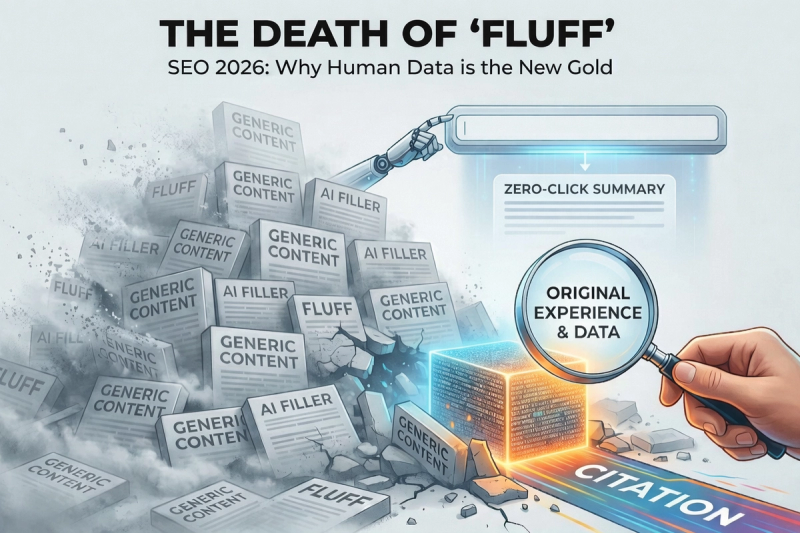
Imagine you are standing in a gigantic library. This library contains every book, every essay, and every piece of paper ever written in human history. For the last twenty years, this library was Google.
When you walked in and asked, "How do I bake a cake?", the librarian didn't answer you directly. Instead, she pointed to a dusty shelf and said, "I found ten books that talk about cakes. Go read them and find the answer yourself."
Because of this system, website owners spent years writing millions of simple, generic "books." They wanted to be the first one the librarian pointed to. They wrote basic definitions like "A cake is a sweet food made from flour." They did this just to get you to open the book so they could show you an ad for baking pans.
But in 2026, the game changed. The librarian was fired.
In her place, the library hired a genius Robot. Now, when you ask, "How do I bake a cake?", the Robot doesn't point to a shelf. It has already read every book. It looks at you and says, "You need two cups of flour, one cup of sugar, and three eggs. Bake at 350 degrees. Here is the recipe."
You take the answer and leave. You never walked to the shelf. You never opened a book.
This shift is why "Generic Content"—or what we call "Fluff"—is dying. If your website only repeats what the Robot already knows, the Robot will never send anyone to visit you.
To survive in this new world, you need to understand exactly why the old tricks stopped working and what you can do to make sure you don't disappear.
The Difference Between a Copycat and an Expert
To understand why websites are losing traffic, we have to define what "Fluff" actually looks like. It’s a lot like cheating on a homework assignment.
Think back to school. Imagine a teacher assigns an essay on "The Sun."
One student goes to Wikipedia, reads the first paragraph, and rewrites it in his own words. He writes, "The Sun is a star. It is very hot. It is in the center of the solar system." This is true, but it is boring. Everyone knows this. It adds nothing new to the world.
Another student goes into his backyard with a thermometer and a camera. He measures the temperature in the shade versus the sunlight. He takes a photo of a sunspot through a telescope. He writes, "I watched the sun for seven days. My experiment shows that on sunny days, my garden is 15 degrees hotter."
In the world of the internet, the first student is "Generic Content." The second student is "Experience and Data."
For a long time, Google couldn't tell the difference between the two. But the new AI is smart. It knows that the first student just copied information that already exists. The AI doesn't need that student. The AI is that student, but faster.
If you write an article today titled "What is a Washing Machine?", you are the copycat. The AI looks at your article, sees definitions it already knows, and ignores you. You become invisible.
The "Zero-Click" Reality Check
We are now living in a "Zero-Click" world. Data from 2026 shows that more than half of all informational searches on Google end without anyone clicking on a website.
Think about how you use your phone.
In the old days, if you searched "When is the Super Bowl?", you had to click on a sports news website, wait for it to load, scroll past three ads, and finally find the date.
Today, you search the same thing, and the AI summary at the top of the screen just says: "Sunday, February 8, 2026."
You have your answer. You close your phone. The website that wrote a 1,000-word article about the Super Bowl gets zero visitors.
This is happening for almost every simple question. "How do I tie a tie?" gets a diagram. "Is a tomato a fruit?" gets a "Yes." If your blog posts are built to answer these simple questions, you are trying to sell water to a fish. The fish doesn't need to buy your water; it is already swimming in it.
Google uses a system called "NavBoost" to track what users do. If people see your article in the search results but don't click on it because the AI answered them, Google stops showing your article entirely. Generic content isn't just ignored; it is actively buried.
The Robot’s Only Weakness (And Your Big Opportunity)
So, if the AI knows everything, should we just give up? Should we stop writing?
Absolutely not. Because the Robot has a massive, secret weakness.
The Robot has no body.
The Robot cannot taste a hamburger. It cannot feel the pain of running a marathon. It cannot accidentally break a vacuum cleaner while trying to clean a rug. It cannot have an opinion. It can only summarize what humans have written in the past.
This is where you win.
Google has updated its rules to focus on "Experience." This is the weapon you use to kill the fluff.
Let's go back to the washing machine example. The AI can tell you how a washing machine works. But it cannot tell you what it feels like to use one.
A winning article in 2026 looks like this: "I tested the Samsung X500 washing machine for six months with two muddy dogs and a baby. The 'Pet Hair' cycle actually works, but the filter gets clogged every three weeks. Here is a picture of the clogged filter so you know what to look for."
This wins for three reasons. First, it has new data—the AI didn't know the filter clogs because that isn't in the manual. Second, it has proof—the AI cannot fake a picture of your specific dirty filter. Third, it solves a complex problem ("Is this machine good for pets?") rather than a simple one ("What is a machine?").
You must stop writing definitions and start writing stories.
The Secret Weapon: "Information Gain"
There is a concept you need to learn called "Information Gain."
Imagine a bucket. This bucket represents "What Google already knows about a topic." If you write a generic article, you are pouring water into a bucket that is already full. The water just spills over. Google doesn't need it.
Information Gain means adding a drop of red dye to the water. You are changing the water. You are adding something that wasn't there before.
You can do this in a few specific ways.
The best way is through Original Data. Don't just write "Email marketing is good." Instead, survey 100 people. Write, "We asked 100 teenagers if they read email. 80% said 'No, we only use TikTok DMs'." That is a fact that belongs to you. If the AI wants to tell people about teenagers and email, it must cite you. It cannot steal this fact because you created it.
Another way is to have a Contrarian Opinion. The AI usually summarizes the "average" view. If everyone says "Wake up at 5 AM to be successful," the AI will say that too. You can stand out by writing, "Why waking up at 5 AM ruined my productivity: A 30-day experiment." It offers a unique perspective that the "average" data doesn't have.
Finally, look for the Gap. Big websites cover big topics like "How to travel to Paris." But they miss the details. You can write, "How to travel to Paris in a wheelchair: A guide to the 5 accessible Metro stations." The AI might know general travel tips, but it might not know which elevator in the Paris Metro is broken today. You do.
Stop Writing for Robots. Start Talking to Friends.
For years, SEO experts told you to "stuff keywords." They told you to write the word "Best Pizza" fifty times so Google would find you. In 2026, if you do that, you look like spam.
The new rule is simple: Write like you are talking to a friend at a dinner party.
If you are at a party and someone asks, "How is that new movie?", you wouldn't say, "The new movie is a visual motion picture released in 2026. Movies are a form of entertainment." That is robotic. Your friend would walk away.
You would say, "Honestly, the ending was terrible, but the special effects were cool. You should wait until it's on streaming."
Your blog must sound like that second example. Use the word "I" or "We." Say "I found that..." or "In my opinion..." This signals to the reader (and the search engine) that a real human is behind the keyboard.
And because text is cheap—anyone can generate 5,000 words in seconds—you need visual proof. If you write a recipe, you need a photo of the cake in your kitchen, with your messy counter in the background. If you use a perfect, shiny stock photo, people will assume you are fake. Imperfection is trustworthy. A shaky video of you holding the product is worth ten times more than a professional studio photo.
Build a Spider Web, Not a Laundry List
So, we know we shouldn't write generic "What is" articles. But how should we organize our site?
Think of your website like a spider web.
In the center of the web is your "Pillar Page." This is a massive, detailed guide based on your experience. For example, "The Ultimate Guide to Training a Stubborn Dog."
Connected to that center are "Cluster Pages." These answer very specific questions that support the main guide. One might be, "How to stop a Beagle from howling at 3 AM." Another might be, "Review of the 'GoodBoy' training collar: Did it hurt my dog?" Another could be a video titled, "Watch me teach a dog to 'Sit' in 5 minutes."
When the Robot scans your site, it sees that you didn't just copy a definition of "Dog Training." It sees you have covered every tiny, specific angle. It sees you have videos, reviews, and specific breed advice. It concludes that you are a "Topical Authority." When you have authority, you can sometimes rank for the generic terms too, simply because you are the most trusted source.
Why Your Name Matters More Than Your Keywords
The final piece of the puzzle is your identity.
In the past, you could run an anonymous website and make money. No one knew who you were. In 2026, Google is trying to verify "Entities." An Entity is a real thing—a real business, a real person.
If Google cannot find you on LinkedIn, YouTube, or other social platforms—if it cannot prove you exist in the real world—it will treat your content as "Synthetic" or fake.
You need to be mentioned by other real people. If you write about cooking, get a local newspaper to mention your blog. If you write about tech, get interviewed on a podcast. These "mentions" are the new backlinks. A link from a random website doesn't matter much. A mention from a trusted source tells the Robot, "This person is real. Listen to them."
The End of Lazy Marketing
The death of "Fluff" sounds scary, but it is actually a good thing.
It means the internet is cleaning itself up. It means we don't have to scroll through pages of nonsense just to find a simple answer.
For you, the content creator, it means the bar is higher. You cannot be lazy. You cannot just copy-paste. You have to do the work. You have to be an expert.
Before you publish your next post, ask yourself: Does this article answer a question the AI can answer in two seconds? Do I have original data or photos? Is my tone human? Did I add something new to the bucket?
If you follow these rules, you won't just survive. You will thrive. Because while everyone else is using AI to write boring fluff, you will be the only human in the room worth listening to. And being human is the only thing the Robot can never replace.
Success is the result of perfection, hard work, learning from failure, loyalty, and persistence.
Phil Martinez
Frequently Asked Questions
No, SEO is not dead, but "traffic arbitrage" is. You can no longer easily get traffic to low-quality sites. SEO has evolved into GEO (Generative Engine Optimization). The goal is now to be cited as the source of truth by AI engines, rather than just ranking for ten blue links.
Use the "2-Second Rule." Type your article’s main question into ChatGPT or Google Gemini. If the AI provides a complete, satisfactory answer in two seconds, your content is fluff. If your content provides unique data, personal stories, or photos that the AI cannot generate, it is not fluff.
You should use AI for research and structure, not for the final draft. Use AI to find gaps in your competitor's content or to create an outline. However, the final writing must have a human voice ("I," "We"), strong opinions, and real-world examples to pass Google’s E-E-A-T filters.
Information Gain. Google prioritizes content that adds new information to its index. If you are repeating what is already on Wikipedia, you have zero Information Gain. If you publish a new case study with original statistics, you have high Information Gain, and you will rank.
Tagged with: