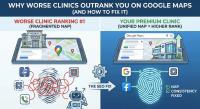


Why Worse Clinics Outrank You on Google Maps (And Fix It)

Vlad Postelnicu
CEO
·
·
Competitors with inferior medical services outrank you on Google Maps because of their local SEO strategy.
Google is an algorithm, not a medical board. It cannot evaluate clinical outcomes, bedside manner, or the sterilization standards of your equipment. It only reads structured data. If your clinic fails to feed the algorithm clear, consistent, and dominant data across the internet, it bypasses you in favour of a competitor who does.
Your million-euro facility is irrelevant to Google if your digital infrastructure is broken.
The Three Pillars of the Local Pack
When a patient searches for "cardiolog București" or "RMN genunchi Cluj", Google displays the "Local Pack" (the map with three clinic listings). Getting into those three spots is dictated by three strict algorithmic factors:
Relevance: How well your digital profile matches the specific medical search term.
Distance: The physical proximity of the searcher to your clinic's verified address.
Prominence: How well-known and trusted your clinic is across the wider internet.
You cannot control the user's distance. You can absolutely control relevance and prominence. The clinics outranking you are currently beating you in these two categories.
NAP Consistency: The Foundation of Prominence
Your competitors outrank you because they maintain strict NAP consistency.
NAP stands for Name, Address, and Phone Number. Search engines use this exact data set across the internet to verify your business is legitimate, operational, and located exactly where you claim it is.
Every time your competitor's NAP data appears perfectly identical on a medical directory, social media platform, or local business listing, it signals trust. This is your "digital fingerprint".
The Cost of a Fragmented Digital Footprint
If your clinic's data is inconsistent, Google loses trust in your data's accuracy.
For example, if your Google Business Profile says "Clinica Ortomed," your website footer says "Centrul Medical Ortomed," and an old listing on Romedic has a disconnected phone number, your footprint is fragmented.
When the algorithm encounters conflicting data, it penalises your ranking. If your data is messy, your clinic becomes invisible on Google Maps.
Romanian Medical Aggregators You Must Audit
To fix your prominence, you must audit and correct your data on the specific directories that Google crawls to verify Romanian medical businesses. You must ensure your NAP matches your Google Business Profile exactly—down to the street abbreviations (e.g., "Bdul." vs "Bulevardul").
Audit your profiles on these platforms immediately:
- Romedic.ro
- SfatulMedicului.ro
- PaginiAurii.ro
- ReginaMaria.ro / MedLife.ro (if you are a partner clinic)
- Doc.ro
- Facebook / LinkedIn / Instagram profiles
Engineering Your Google Business Profile (GBP)
Claiming your GBP is the bare minimum. The clinics beating you are actively optimising their profiles for local search intent.
Primary vs. Secondary Categories
Your Primary Category dictates your overall relevance. Many clinics make the mistake of choosing a generic primary category like "Medical Clinic" when they actually specialise in something specific.
If you run an orthopaedic surgery centre, your Primary Category must be "Orthopaedic Surgeon" or "Orthopaedic Clinic". "Medical Clinic" should be relegated to a Secondary Category.
- Primary Category (Critical Algorithmic Weight): The most specific definition of your primary medical revenue driver.
- Secondary Categories (High Algorithmic Weight): Additional specialties (e.g., "MRI Center", "Physical Therapy Clinic").
- Services Menu (Medium Algorithmic Weight): A structured list of individual procedures (e.g., "Knee Replacement", "Meniscus Repair").
UTM Tracking on GBP Links
Google Analytics frequently misattributes traffic from Google Maps as "Direct" traffic. If you do not use UTM parameters on the website link inside your GBP, you are flying blind.
Change your primary website link in GBP from https://www.yourclinic.ro to: https://www.yourclinic.ro/?utm_source=google&utm_medium=organic&utm_campaign=gmb
This forces Google Analytics to correctly attribute patient bookings generated by your Maps listing.
Algorithmic Review Management
Having a 5-star rating is not enough. Google's algorithm reads the text inside the reviews to understand your relevance.
A review that says, "Great doctor, highly recommend!" carries zero SEO value.
A review that says, "Dr. Popescu performed an excellent ACL reconstruction surgery on my left knee at this clinic in Timișoara," is packed with high-value local and medical keywords.
Review Velocity and Keyword Priming
The clinics outranking you have a system for generating consistent, keyword-rich reviews.
Velocity: Google tracks how often you get reviews. Getting 20 reviews in one week and then zero for six months looks unnatural. You need a steady, ongoing stream of patient feedback.
Priming: When you ask a patient for a review, prompt them to mention the specific procedure and the city. Send a post-appointment email stating: "We are glad your [Procedure Name] went well. Could you leave a review mentioning your experience with our [City Name] clinic?"
Response Rate: You must respond to every single review. The algorithm tracks your response rate. Use your responses to naturally inject keywords. (e.g., "Thank you for trusting our Bucharest cardiology clinic with your care.")
On-Site Local SEO Infrastructure
Your Google Maps ranking is directly tied to the SEO strength of your actual website. If your website is poorly structured, your Maps listing suffers.
Dedicated Location Pages
If your clinic operates in multiple locations (e.g., Bucharest and Brașov), you cannot rely on a single "Contact Us" page.
You must build dedicated landing pages for each location. The URL structure should be: www.yourclinic.ro/locatii/bucuresti www.yourclinic.ro/locatii/brasov
Each location page must contain:
- The exact NAP data for that specific branch.
- An embedded Google Map of that specific clinic.
- The specific doctors who operate at that location.
- Location-specific reviews.
Local Business Schema Markup
Schema markup is code you inject into your website's backend that spoon-feeds your exact data to Google’s algorithm. It removes all guesswork.
If your website lacks Local Business Schema, you are forcing Google to crawl your text to figure out your address.
You must implement JSON-LD Schema on your site. The code must specify your MedicalClinic type, exact GPS coordinates, opening hours, and your official NAP data. This is a technical requirement, not an optional upgrade.
The 48-Hour Technical Audit Plan
Stop complaining about competitors and fix your data. Execute this audit within the next 48 hours:
Run a NAP Search: Search your exact clinic phone number on Google. Identify every directory displaying old or incorrect addresses.
Standardise the Data: Create a master spreadsheet with your exact, desired Name, Address, and Phone Number.
Execute Corrections: Manually log into Facebook, Romedic, PaginiAurii, and local business directories. Force the data to match your master spreadsheet perfectly.
Optimise GBP Categories: Log into your Google Business Profile. Verify your Primary Category is your most profitable medical specialty, not just "Medical Center."
Implement UTM Tracking: Update your GBP website link with UTM parameters so you can actually track your local SEO ROI in Google Analytics.
Deploy Schema Code: Instruct your web developer to implement MedicalClinic JSON-LD schema on your homepage and location pages immediately.
By standardising your digital fingerprint and feeding the algorithm exactly what it wants, you signal the trust required to dominate local search.
Success is the result of perfection, hard work, learning from failure, loyalty, and persistence.
Phil Martinez
Frequently Asked Questions
NAP stands for Name, Address, and Phone Number. Search engines cross-reference this exact data across the internet to verify your clinic's legitimacy, operational status, and precise location.
Your digital footprint is likely fragmented. If your clinic's NAP data is inconsistent across directories (like Romedic, PaginiAurii, or Facebook), Google’s algorithm loses trust in your data and penalises your ranking, regardless of your physical clinic's quality.
Choosing a generic Primary Category. Setting your primary category as "Medical Clinic" instead of your specific specialty (e.g., "Orthopaedic Surgeon" or "Cardiologist") destroys your relevance for high-intent, procedure-specific searches.
Yes, but the text matters more than the star rating. Google’s algorithm scans review text for keywords. A review mentioning a specific procedure and your city (e.g., "great ACL surgery in Cluj") directly boosts your algorithmic relevance; a generic "great doctor" review does not.
It is structured JSON-LD code injected into your website's backend. It spoon-feeds your clinic's exact NAP data, GPS coordinates, and medical specialty directly to search engine bots, removing their need to guess your information from plain text.
Tagged with:
strategy