

The Great Fragmentation: Why "Search" No Longer Means Google

Radu Mazare
CEO
·
·
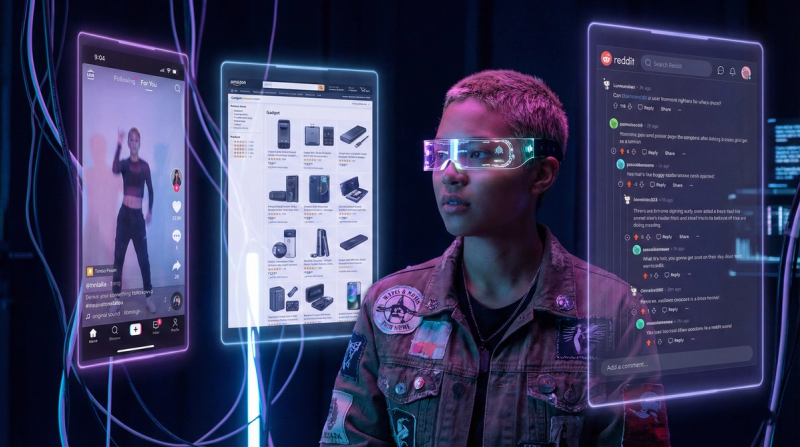
For two decades, the digital marketing industry operated under a comfortable monopoly. When we said "Search," we meant Google. When we said "SEO," we meant optimizing text for a specific set of algorithms designed in Mountain View. It was a linear, predictable world. You picked a keyword, you wrote an article, you built links, and you waited for the traffic.
That era is over.
We are not just witnessing a change in algorithms; we are witnessing a fundamental fracture in human behavior. The concept of "Search" has not disappeared, but it has exploded. It has fragmented across a dozen different platforms, each serving a specific psychological need that Google can no longer satisfy alone.
If you are still pouring 100% of your organic budget into ranking for "blue links," you are optimizing for a ghost town. Your audience hasn't stopped searching; they have just stopped "Googling" for discovery.
This is the reality of the Search Everywhere ecosystem in 2026.
The Unbundling of the Search Bar
To understand the future, we have to acknowledge the limitations of the past. For years, Google was the "Everything Store" of information. Whether you wanted to buy a pair of running shoes, learn how to tie a tie, or find a restaurant for dinner, you went to the same white bar.
But specialization was inevitable. As the internet matured, users realized that a generalist engine is rarely the best tool for specific intent.
Today, the search landscape has split along the lines of User Intent:
- To Buy: Users go to Amazon. They skip the middleman.
- To Feel/Verify: Users go to TikTok or YouTube. They need visual proof, not text claims.
- To Trust: Users go to Reddit. They want human consensus, not corporate copy.
- To Plan: Users go to Pinterest. They want to visualize a future state.
- To Navigate: Users go to Google. They want a specific website or a quick fact.
Google has transitioned from being a "Discovery Engine" to a "Utility Engine." It is still massive, and it is still necessary, but it is no longer the starting line for culture or commerce.
The Visual Validation Engine: TikTok & YouTube
The most dangerous misconception in boardrooms today is the belief that TikTok is merely a "social media" channel for entertainment. This view is obsolete.
For the modern consumer, TikTok and YouTube are Visual Search Engines.
Consider the psychology of a purchase in 2026. Text is cheap. Text is now infinitely reproducible by AI. Anyone can generate a 2,000-word review of a product they have never touched. The consumer knows this. They have developed a subconscious "blindness" to polished blog posts and affiliate marketing sites.
They crave Proof of Life.
When a user searches for "best travel backpack" on TikTok, they aren't looking for a spec sheet. They are looking to see how the zippers move. They want to see how it looks on a real person’s back, not a studio mannequin. They are searching for the "vibe" and the reality of the object.
The Strategy Pivot: Your SEO strategy must expand to include VSEO (Video Search Engine Optimization).
- Keywords in Audio: Algorithms now transcribe and index spoken words with high precision. Your script is your meta-data.
- Text-on-Screen: The visual overlays in your videos are read by optical character recognition (OCR) and contribute to search relevance.
- The "Hook" as a Headline: In Google SEO, the H1 tag told the bot what the page was about. In TikTok SEO, the first 3 seconds of visual context tell the algorithm who this content is for.
If you are invisible on video search, you are invisible during the "consideration" phase of the buyer's journey.
The Walled Garden of Commerce: Amazon
If TikTok is where desire is created, Amazon is where it is captured.
Data indicates that the majority of product searches now begin directly on marketplaces, bypassing the open web entirely. This is a terrifying statistic for brands that rely solely on their Direct-to-Consumer (DTC) websites.
"Amazon SEO" operates on a completely different set of physics than Google. Google tries to answer the question: "Is this the most authoritative answer?" Amazon asks a colder, more capitalist question: "Is this the product most likely to generate a transaction right now?"
The metric for success here isn't backlinks; it is Sales Velocity.
- Conversion is Ranking: On Google, high traffic can lead to sales. On Amazon, high sales lead to traffic. It is a flywheel.
- Structured Data: You cannot "storytell" your way to the top of Amazon. You win through precise backend keywords, attribute mapping, and optimizing image galleries for click-through rate (CTR).
For a marketing agency in 2026, ignoring Amazon (or local equivalents) is malpractice. You cannot claim to manage a client's "Search Strategy" if you are ignoring the platform where the actual searching for products happens.
The Trust Protocol: Reddit & Community Search
We are living in a crisis of trust. Between AI hallucinations and hyper-optimized spam, users are retreating to digital enclaves where they feel safe.
This is why Reddit has become one of the most powerful search engines on the planet.
Users have learned a simple hack: they append the word "reddit" to their Google searches. They do this because they are desperate for unpolished, human opinion. They want to hear from the person who used the software for two years and hated it, not the "Top 10 Software" listicle that was paid for by affiliate links.
The Strategy Pivot: You cannot "optimize" for Reddit in the traditional sense. You cannot spam keywords. You must optimize for Presence.
- Brand Monitoring: Your agency needs to know every time your client’s brand is mentioned in a thread.
- Participation: You need valid, helpful accounts that contribute to the community without overtly selling.
- The "Answer" Strategy: When a user asks a question about your industry, your brand needs to be the one providing the most helpful, non-promotional answer. Over time, these threads rank on Google, creating a symbiotic loop between Community and SEO.
Generative Optimization: The AI Factor
Finally, we must address the "Answer Engine." Tools like ChatGPT, Gemini, and Perplexity are changing search from a retrieval task to a synthesis task.
In the old world, a user searched for "CRM software," opened five tabs, read them, and synthesized the answer. In the new world, the user asks the AI: "Compare the top 3 CRMs for a small real estate business." The AI does the reading. The AI does the synthesis.
If your content is not structured in a way that is easily ingestible by Large Language Models (LLMs), you will not be cited in the answer.
The Strategy Pivot: We are moving from SEO to GEO (Generative Engine Optimization).
- Fact-Density: Fluff is fatal. AI models prioritize content that is dense with facts, statistics, and clear logical propositions.
- Brand Authority: AI cites sources it deems "credible." This brings us back to Digital PR. Being mentioned in high-authority publications is no longer just about link juice; it’s about teaching the AI that your brand is a reference entity in your sector.
The Verdict: Integration or Irrelevance
The days of the siloed SEO Specialist are numbered. You cannot have one person doing "Google stuff" in a corner while a creative team makes "social stuff" in another room.
The "Search Everywhere" mandate requires a unified view of the internet.
When we create a piece of core content, we must fracture it immediately:
The Blog Post: For Google and detailed research.
The Video Script: For TikTok and YouTube intent.
The Marketplace Listing: Optimizing the product page for transactional velocity.
The Community Angle: Engaging in the discourse on Reddit and specialized forums.
This is harder work. It is messier. It requires more diverse skill sets. But it is also more resilient.
If you rely 100% on Google, you are at the mercy of a single algorithm update. By pivoting to a "Search Everywhere" strategy, you build a diversified portfolio of attention. You meet the user where they are, not where you wish they were.
In 2026, the question isn't "Do we rank #1?" The question is: "Are we omnipresent?"
Success is the result of perfection, hard work, learning from failure, loyalty, and persistence.
Phil Martinez
Frequently Asked Questions
No, Google SEO is not dead, but it has evolved into a utility engine for specific answers. A modern strategy must diversify beyond Google to capture intent on platforms like TikTok (discovery) and Amazon (transaction).
'Search Everywhere' is the practice of optimizing content for the specific platform where user intent originates. This includes optimizing video for TikTok, product listings for Amazon, and community presence for Reddit, rather than focusing solely on Google rankings.
GEO is the process of optimizing content to be cited by AI Answer Engines (like ChatGPT, Gemini, and Perplexity). It focuses on fact-density, authority, and structured data so that Large Language Models (LLMs) reference your brand in their synthesized answers.
TikTok SEO involves optimizing audio scripts (keywords must be spoken), using on-screen text overlays (for optical character recognition), and focusing on high-retention visuals to satisfy the algorithm's "watch time" metric.
Tagged with:
seo
strategy