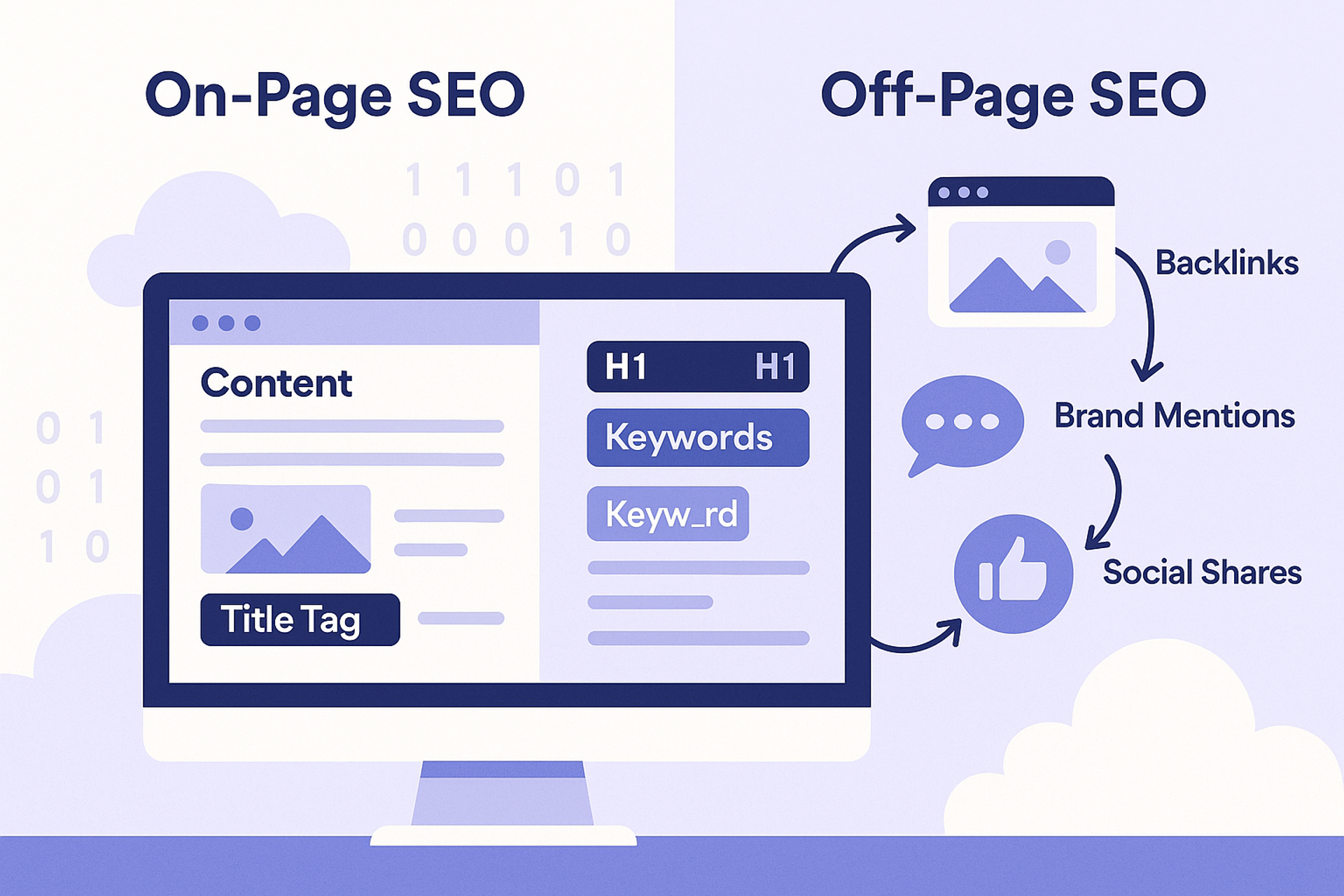

Why a Medical Website Alone Won't Get Appointments

Vlad Postelnicu
CEO
·
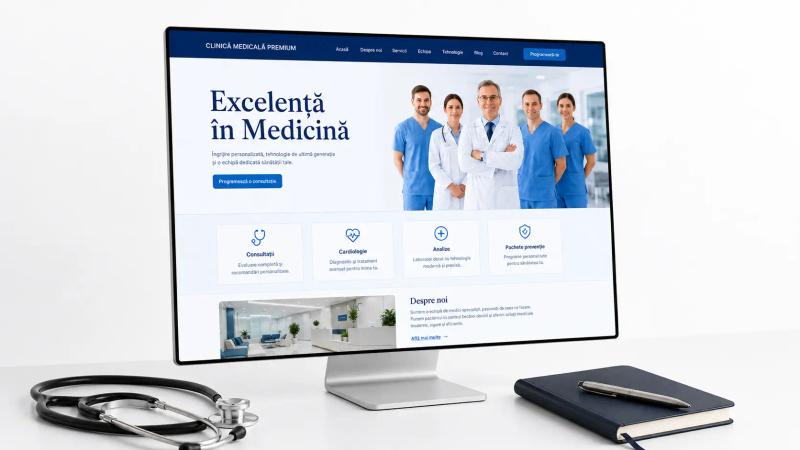
The paradox of a beautiful website with no patients
One of the most frequent conversations in early meetings with clinic founders starts at the same point. The clinic already has a working website. It is online, it lists the doctors, the services and the contact details. And yet, the concrete results are far below expectations. The site exists, but it behaves more like a passive digital business card. Despite its online presence, it does not produce appointments at the anticipated volume.
This pattern is so common that it should be treated as the rule, not the exception. Most clinics that invest in a new website believe they have bought an asset that will produce patients. In reality, they have bought a destination with no road leading to it. And a destination with no road is, in the digital space, exactly as invisible as a clinic with no sign on the street.
Effective medical marketing is not built around the website as an isolated object. It is built as a system with three interdependent pillars, of which the website is only one. If either of the other two pillars is missing, the whole system performs below potential, regardless of how beautiful the site is.
This article explains, concretely, what those three pillars are, why a site alone is not enough to produce appointments, and what is actually needed for a medical clinic to turn a website investment into a real growth engine.
The site as a destination versus the site as an asset
The difference between a site that produces and one that does not is, in most cases, not a difference of visual quality. It is a difference of strategic position. A website is, fundamentally, a destination, a page a visitor lands on. For a destination to become an asset, there has to be a mechanism that brings visitors to it consistently, and a mechanism that, once they arrive, convinces them to act.
A site without a mechanism to bring visitors is, technically, an unused asset. 54 percent of healthcare website traffic comes from organic search, and around 76 percent comes from organic and paid search combined, according to Searchlab. A clinic that does not appear in the first results for its key local searches has the majority traffic source effectively closed.
A site without a mechanism to convert visitors is, in turn, an unused asset. The median healthcare website converts roughly 3 to 4 percent of visitors, which means the large majority leave without booking, while the top quarter of healthcare landing pages convert far higher, above 20 percent, according to consolidated benchmarks. The gap between the median and the top is not luck, it is structure.
And a site without a mechanism to be recognized as legitimate is, in the private medical market, ineffective. A visitor who does not receive clear trust and authority signals in the first seconds on the site does not book, no matter how easy the form is.
The three pillars that turn a site from a destination into an asset are organic traffic, perceived authority, and channel consistency. Without any one of them, the site remains an expense, not an investment.
Pillar 1: local SEO, without organic traffic the site is not found
The first missing link, for most clinics, is the absence of a local SEO strategy. The site exists technically on the internet, but for the prospective patients searching for a new clinic in their area, it is invisible, because it does not appear in the first Google results or in the Google Maps Local Pack.
Local SEO for a medical clinic is not an obscure technical discipline. It is, in essence, the way the site communicates three specific things to Google, who you are, where you are and what you do, in a format the algorithm can understand and rank correctly against the competition. Local intent is rising fast, with "near me" healthcare searches growing strongly over the past decade, so the clinics that rank locally capture a growing share of demand.
The components of a correct local SEO strategy for a medical clinic include optimizing the Google Business Profile, with the correct primary category, fully listed services, updated hours and real photos, building a structure of URLs and pages optimized for each service and each location, schema markup so the clinic is recognized automatically as a medical provider, systematizing Google review requests, and publishing content regularly that answers the specific searches prospective patients make.
This construction does not produce instant results. First traffic gains typically appear after several months, stabilization on competitive positions later, and full recovery of the initial investment later still. After that point, the traffic produced by SEO keeps being generated month after month, with no additional per-click cost, an asset that compounds over time, unlike paid acquisition, which decays the moment the budget stops.
Without local SEO, the site remains, structurally, a destination with no road. Without a road, the destination is useless.
Pillar 2: perceived authority, without trust signals the visitor does not act
The second missing link, for most clinics, is the absence of perceived authority signals inside the site. The site brings visitors, whether through SEO or paid ads, but those visitors, once there, do not act. Strengthening trust signals inside a medical site measurably lifts conversion, and given that the median site converts only 3 to 4 percent, that lift is the difference between a passive page and a productive one.
Perceived authority on a medical site is not a vague feeling. It is built from concrete signals, placed strategically where visitors make micro-decisions.
Doctor profiles. Sites with complete profiles for each doctor, real photo, biography with specializations and years of experience, published articles or interviews, visible certifications, convert better than those with generic "About the team" pages. The doctor profile is, in the medical market, the strongest trust signal inside the site.
Visible reviews. Sites that pull real Google reviews and display them on the main pages and the service pages produce a consistent lift in conversion. Visitors who checked reviews on Google earlier find, on the site, confirmation of the positive hypothesis, which reduces the friction of the decision.
Experience figures. The number of patients treated, the team's cumulative years of experience, the number of cases handled for a given procedure. These are objective authority signals, easy to verify and hard to fake.
Educational content. Articles, guides and videos that educate the patient about their condition, the available procedures and the criteria that distinguish a specialist. A site with an active blog section communicates authority indirectly. A clinic that takes the time to educate prospective patients is perceived as more serious, and structured educational content is also what AI assistants and search engines surface most readily.
Operational transparency. Published prices or ranges, detailed descriptions of the consultation process, explanations of what happens at the first visit. The absence of this information is, in the current market, interpreted as opacity.
Without these signals, the site is a beautiful shop window with the products turned to face the wall. The visitor sees, but cannot evaluate. And without evaluation, the decision stays open, which in most cases means leaving for another site.
Pillar 3: channel consistency, without a coherent ecosystem the site is an orphan
The third missing link, the least discussed, is the absence of consistency across the ecosystem of communication channels the site sits inside. A site without a coherent ecosystem around it is, in the digital space, a puzzle piece without the other pieces, it exists, but it does not produce the full picture.
The new patient who reaches the clinic's site never arrives directly. They arrive after a sequence of contacts with the brand, in which the site is just one point. That sequence can include a Google search, a view of the Google Business Profile, a read of the reviews, a visit to the Instagram or Facebook page, a read of an article published by the clinic, an interaction with a paid ad. The site is the point of convergence of these channels, not the starting point.
If these channels are not consistent with one another, the visitor reaches the site with a set of expectations that are not confirmed. And they leave. Consistency across channels rests on four alignments.
Visual alignment. Branding, colors, typography and photographic style identical on the site, the Google Business Profile, Instagram, Facebook, ads and the clinic's printed materials. A visitor who sees the clinic's Instagram in one style and the site in another perceives inconsistency, which in the medical market translates directly into a lack of trust.
Message alignment. The same positioning, the same core services, the same approach to the patient, communicated consistently across all channels. A clinic that communicates "affordable prices" on Instagram and "premium medicine" on the site loses, in the visitor's perception, any clarity of positioning.
Information alignment. The same hours, the same phone number, the same address, the same listed services, across every channel. Inconsistencies here are read as carelessness, a strong risk signal in the patient's perception.
Continuous communication alignment. Email marketing that continues the conversation after the first site visit, nurture sequences that educate the prospective patient, automated follow-up for visitors who did not book. A site with no communication queue behind it loses the large majority of its visitors for good, because there is no mechanism to reach them again, reactivate them, or convert them over time. Speed of response matters just as much: practices that respond to an inquiry within five minutes are far more likely to convert it than those that wait, according to lead-conversion research.
Without this cross-channel consistency, the site is, in the patient's perception, a single piece with no context. And a piece with no context is, systematically, a piece visitors do not buy.
How a working site differs from one that does not
The operational difference between a site that produces appointments and one that does not is visible in the numbers, once these three pillars are in place.
A site that does not work has low organic traffic, a conversion rate below the median, weak or absent authority signals, and no mechanism to continue the conversation with visitors who left. In absolute terms, this site produces very few appointments from digital channels, regardless of the paid acquisition budget feeding it.
A site that works has substantial organic traffic, an above-median conversion rate, authority signals visible in the first seconds, and an automated communication sequence that reactivates visitors who did not book on the first visit. This site produces a meaningfully larger flow of appointments from digital channels.
The difference between the two is not a difference of design. It is a structural difference, a system with three interdependent pillars, versus a single site with no infrastructure around it.
The correct balance between the three pillars
Building these three pillars simultaneously, from scratch, is impractical financially and operationally for most clinics. The pragmatic recommendation is a prioritization sequence over twelve to eighteen months.
First, the perceived authority pillar on the site. Doctor profiles, integrated reviews, transparency, conversion optimization. This is the pillar with the fastest effect on the conversion rate of existing traffic.
Next, the cross-channel consistency pillar. Aligning the Google Business Profile, social media and automated email marketing, nurture sequences. This is the pillar that reduces the loss of visitors who do not book on the first visit.
Then, the local SEO pillar. Keyword strategy, on-page optimization, regularly published content, local backlinks. This is the pillar with the slowest payback, but the strongest compounding effect over the long term.
This sequence builds the system in the order in which each pillar adds maximum value on top of the previous ones. Reversing it, investing in SEO before optimizing conversion, produces, systematically, results below potential.
Conclusion: the site is a pivot, not a product
The fundamental reframe of this article is this. A website, no matter how well built aesthetically, is not, today, a product that produces patients on its own. It is a pivot, the point of convergence of a system with three interdependent pillars. Without the organic traffic that feeds it, without the perceived authority that converts visitors, without the cross-channel consistency that integrates it into the clinic's marketing ecosystem, the site remains a beautiful destination, but with no road and no trust signal.
Modern medical marketing, in this perspective, is not about building a website. It is about building the system in which the website becomes a productive asset. And that construction, if it is not done systematically, leaves the initial website investment below potential, sometimes for months, sometimes for years.
For a concrete analysis of the three pillars in your clinic's case, your organic traffic, your perceived authority and your channel consistency, request a free evaluation session.
Sources
Searchlab, Healthcare Marketing Statistics 2026: https://searchlab.nl/en/statistics/healthcare-marketing-statistics-2026
First Page Sage, Patient Conversion Rate by Practice Type: 2025 Report: https://firstpagesage.com/reports/patient-conversion-rate-by-practice-type/
Marketing Dive, Google: 53% of Mobile Users Abandon Sites Slower Than 3 Seconds: https://www.marketingdive.com/news/google-53-of-mobile-users-abandon-sites-that-take-over-3-seconds-to-load/426070/
Google, Mobile Page Speed New Industry Benchmarks: https://business.google.com/ca-en/think/marketing-strategies/mobile-page-speed-new-industry-benchmarks/
InfluxMD, The Medical Practice Lead Conversion Crisis: https://www.influxmd.com/blog/the-medical-practice-lead-conversion-crisis-what-2025-data-reveals-about-winning-patients
BrightLocal, Local SEO Statistics: https://www.brightlocal.com/resources/local-seo-statistics/
WebFX, Healthcare Marketing Statistics: https://www.webfx.com/blog/healthcare/statistics-and-factoids/
First Page Sage, SEO vs Paid Search: A Primer: https://firstpagesage.com/seo-blog/seo-vs-paid-search-a-primer/
Ruler Analytics, Healthcare Marketing Statistics: https://www.ruleranalytics.com/blog/insight/healthcare-marketing-statistics/
BrightLocal, Local Consumer Review Survey: https://www.brightlocal.com/research/local-consumer-review-survey/
Success is the result of perfection, hard work, learning from failure, loyalty, and persistence.
Phil Martinez
Frequently Asked Questions
Because a site alone is only a destination. Without organic traffic to bring visitors, authority signals to convert them, and channel consistency to integrate it, even a beautiful site stays a passive business card.
About 54 percent of healthcare website traffic comes from organic search, and roughly 76 percent from organic and paid search combined, according to Searchlab. A site that does not rank locally loses its largest traffic source.
The median healthcare site converts around 3 to 4 percent of visitors, while the top quarter of healthcare landing pages convert above 20 percent. The gap is structural, not luck.
Organic traffic from local SEO, perceived authority from trust signals on the site, and consistency across all communication channels. Missing any one of them caps the site's results.
First traffic gains typically appear after several months, with stabilization on competitive terms later. After that, organic traffic keeps producing with no per-click cost, compounding over time.
Because 53 percent of mobile users abandon a site that takes more than three seconds to load. Slow loading reads as unprofessional and sends patients to a competitor before they see the content.
Complete doctor profiles with real photos and experience, visible Google reviews, objective experience figures, educational content, and transparent prices or ranges.
Because patients reach the site after seeing several channels. If branding, message, information or follow-up are inconsistent, expectations are not confirmed and visitors leave. Fast response to inquiries, within minutes, strongly improves conversion.
First perceived authority on the site for the fastest conversion lift, then cross-channel consistency to stop losing visitors, then local SEO for long-term compounding traffic.
No. Paid ads can bring traffic, but without authority signals and channel consistency the visitors compare and leave, and the moment the budget stops the traffic stops. SEO and conversion build a lasting asset.
Tagged with:
medical marketing
website