

Why Patients Pick Trust Over the Best Medical Clinic

Vlad Postelnicu
CEO
·
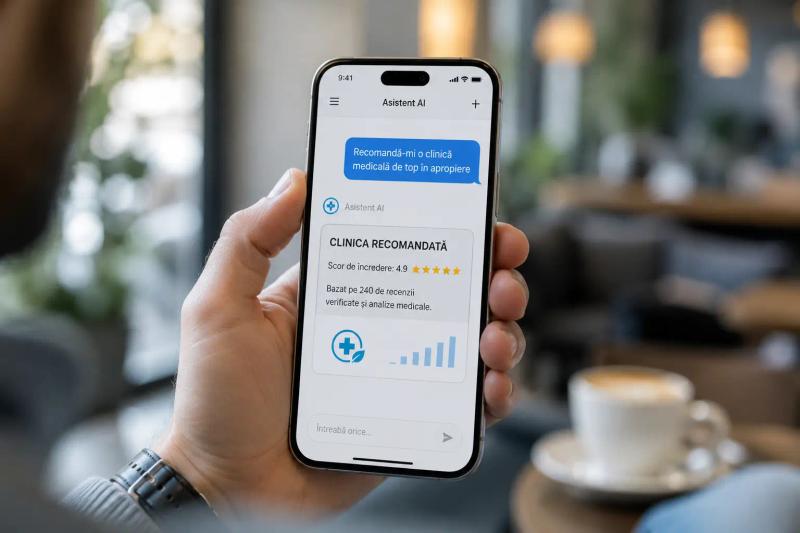
The hidden paradox in real patient behavior
There is a persistent belief among clinic founders. Invest enough in clinical quality, modern equipment, elite specialists and protocols aligned with international standards, and patients will recognize the difference and choose your clinic over the competition.
The reality of the private medical market contradicts this belief systematically. Patients do not choose the best clinic. They choose the clinic they trust most. And these two things, although they sound like synonyms, are fundamentally different.
The gap between them is not a detail of behavioral psychology. It is the consequence of a structural problem called information asymmetry, a concept developed in economics by George Akerlof in 1970 to explain why, in markets where the buyer cannot evaluate quality before purchase, decisions are made on indirect signals rather than on real quality.
This article explains why that asymmetry dominates the private medical market, which signals patients use to decide between two seemingly similar clinics, and why a technically superior clinic can lose patients systematically to a less capable but better-communicated competitor.
Why the medical market does not work like other markets
In 1970, economist George Akerlof published a paper that later became foundational for modern economics, titled "The Market for Lemons: Quality Uncertainty and the Market Mechanism." The paper was initially rejected by several journals and went on to become one of the most cited works in the field. In 2001, Akerlof shared the Nobel Prize in Economic Sciences with Michael Spence and Joseph Stiglitz for their work on markets with asymmetric information.
The premise of the argument is this. When the buyer cannot assess the quality of a product before purchase, while the seller knows the quality, the market tends to fill with lower-quality products. Buyers, unable to tell the difference, offer average prices, which drives good products out of the market.
This dynamic applies to any market with severe information asymmetry between provider and consumer. The private medical market is, structurally, one of the strongest examples. In economics, a service whose quality is hard to judge even after it is delivered is called a credence good, and healthcare is the textbook case.
A patient entering a clinic for a specialist consultation cannot evaluate, in the first five minutes, whether the doctor is excellent or mediocre. They cannot evaluate whether the diagnosis is correct. They cannot evaluate whether the proposed protocol is optimal or commercial. They cannot evaluate whether the equipment is genuinely modern or merely looks modern.
In the absence of these evaluation abilities, the patient builds the decision on proxies, indirect signals that, in their perception, indicate how likely the clinic is to be trustworthy. And most of these signals have no direct link to the real clinical quality of the medical act.
What patients actually evaluate: the categories of trust signals
Research over the past decade identifies several categories of signals patients use to reduce uncertainty when choosing a medical provider.
Patient-generated signals are online reviews, comments, ratings and experiences shared by other patients. These are the most influential, because they come from people perceived to share the same information position as the prospective patient. According to TechTarget reporting on patient access research, 72 percent of patients view online reviews when selecting a new provider, and consumers increasingly trust those reviews nearly as much as personal recommendations.
System-generated signals are the details on the doctor's profile, the biography, visible experience, certifications and tenure. These are perceived as more credible than the clinic's direct promises, because they come from an apparently objective frame rather than a marketing message.
To these is added a third, less-discussed but equally influential category, direct experience signals. The way reception answers, the tone of the confirmation email, the ease of booking, price transparency and the clarity of the language used in communication. The patient experiences all of these before even setting foot in the clinic.
All three categories operate in parallel, and final decisions are made on their cumulative weight, not on the real clinical quality the patient cannot verify before the consultation chair.
Why empathy beats expertise in first-choice decisions
A consistent finding across the medical literature is that perceived physician empathy is strongly tied to patient satisfaction. Studies using validated empathy scales report a strong positive correlation between how empathic a patient perceives their physician to be and how satisfied they are with the care, and research published in peer-reviewed journals shows that empathy mediates the relationship between a physician's communication and the patient's satisfaction, trust and willingness to comply with treatment.
This is not a moral judgment about patients. It is a rational consequence of information asymmetry. The patient cannot directly evaluate medical knowledge. They can directly evaluate empathy, attention, clarity of explanation and patience. And they use these evaluation abilities as a proxy for the underlying medical competence.
The implication for a growing clinic is clear. Investing in pure clinical quality, without an equivalent investment in empathic communication, produces a suboptimal return. The most technically skilled doctors, if they do not communicate with warmth, will lose patients systematically to technically weaker doctors who communicate better. This happens not because patients are irrational, but because, lacking the ability to judge technically, they choose on the only signals they can credibly interpret.
Online presence: the primary trust signal of the decade
The trust signal with the greatest weight has become online presence. It is not one-dimensional. It includes at least five distinct components, each with a cumulative effect on the decision.
The number and quality of Google reviews. Below a certain volume, a clinic reads as emerging. A larger, consistent body of reviews reads as mature. A low average rating reads as risky. A high average reads as recommendable. Consumers read roughly ten reviews before deciding to trust a local business, according to BrightLocal's Local Consumer Review Survey, so the body of reviews has to hold up beyond the first one or two.
The clinic's responses to reviews, especially negative ones. A negative review with no response is read as indifference. A negative review met with a calm, professional, non-defensive reply is, paradoxically, a positive trust signal, because it shows how the clinic behaves when things do not go perfectly. This matters because, according to BrightLocal, 94 percent of consumers say a negative review has convinced them to avoid a business, so the handling of negatives is not optional.
Authentic visual content, real photographs of the clinic, the team and the spaces. Generic stock images erode trust regardless of their aesthetic quality, because they signal a lack of authenticity.
The clarity of public information, transparent prices, updated hours, fully listed services and detailed doctor biographies. The absence of this information is interpreted as a lack of transparency, which in the medical market translates directly into a lack of trust.
The frequency and consistency of public communication. A silent clinic is perceived as uncertain, regardless of the quality of the medical act it provides.
The gap between quality and communication: where the best clinics lose
There is a consistent, paradoxical pattern. Clinics with exceptional clinical quality, large investments in equipment, specialists with verifiable expertise and exemplary protocols, that perform below potential, while technically inferior but better-communicated competitors capture larger patient volumes.
The cause of this gap is not a lack of quality. It is a lack of translation of quality into signals the prospective patient can interpret.
A specialist with twenty years of experience, if that appears in no public text, is, to a new patient, indistinguishable from a specialist with two years of experience. A clinic with modern equipment, if it does not show it and explain what it means concretely for the patient, is indistinguishable from one with old equipment. A rigorous consultation process, if it is not described clearly before booking, is indistinguishable from a superficial one.
In this perspective, medical marketing is not a discipline of promotion. It is a discipline of translation, turning real clinical quality into signals the prospective patient can credibly interpret before stepping into the clinic.
What it means, operationally, to become a clinic patients trust
Building trust systematically is not a vague process of brand image. It is a concrete set of operational actions, organized around five interdependent pillars.
The first pillar is review management. A system through which every satisfied patient is invited to leave a public review in the first week after the visit, and negative reviews receive a calibrated response within a short window.
The second pillar is translating medical expertise. Detailed profiles for each doctor, biographies with specializations and years of experience, educational content published regularly, and presence with name and face on public platforms.
The third pillar is operational transparency. Published prices or, at minimum, clear ranges, constantly updated hours, precise service descriptions, and the absence of vague "price on request" formulas.
The fourth pillar is the quality of direct communication. Reception trained in empathic communication, carefully written confirmation emails, automated follow-up after the visit, and the absence of administrative friction.
The fifth pillar is authentic visual signals. Real photographs of the clinic and team, no generic stock imagery, and consistent branding across every point of contact the patient has with the clinic.
These five pillars, built simultaneously and maintained over time, are not marketing options. They are the structural components of a clinic that converts clinical quality into perceived trust. Without that conversion, real clinical quality remains, to the prospective patient, invisible.
Conclusion: trust is the product, not the medical service
The fundamental reframe of this article is not that you should sacrifice clinical quality to invest in communication. It is that, without investing in the translation of quality into perceived trust, clinical quality alone does not produce growth.
Patients do not buy the medical service. They cannot evaluate it. They buy the trust that the medical service is good. And that trust is built through specific signals that can be designed, measured and optimized systematically, or left to chance, which in the current market is equivalent to a structural underinvestment.
Modern medical marketing, in this perspective, is not a discipline external to the clinic. It is the discipline that connects two realities, the real quality of the medical act and the trust perceived by the prospective patient, which, without it, move independently, against the clinic's interest.
For an evaluation of your clinic's current trust signals, your reviews, your digital presence and the translation of your expertise, request a free analysis session. [contact page link]
Sources
NobelPrize.org, George Akerlof on Writing "The Market for Lemons": https://www.nobelprize.org/prizes/economic-sciences/2001/akerlof/article/
Wikipedia, The Market for Lemons: https://en.wikipedia.org/wiki/The_Market_for_Lemons
Econlib, George A. Akerlof: https://www.econlib.org/library/Enc/bios/Akerlof.html
Frontiers in Medicine, The mediating role of patient satisfaction in physician empathy: https://www.frontiersin.org/journals/medicine/articles/10.3389/fmed.2025.1647105/full
PMC, Mediating role of physician empathy between communication and patient satisfaction: https://pmc.ncbi.nlm.nih.gov/articles/PMC11142003/
PMC, Patient perceptions of physician empathy, satisfaction, trust and compliance: https://pmc.ncbi.nlm.nih.gov/articles/PMC4205510/
TechTarget, 72% of Patients View Online Reviews When Selecting a New Provider: https://www.techtarget.com/patientengagement/news/366584933/72-of-Patients-View-Online-Reviews-When-Selecting-a-New-Provider
BrightLocal, Local Consumer Review Survey: https://www.brightlocal.com/research/local-consumer-review-survey/
PatientEngagementHIT, More Patients Value Online Provider Reviews: https://patientengagementhit.com/news/more-patients-value-online-provider-reviews-in-patient-access
Healthgrades, How a Strong Online Presence Helps Doctors Get More Patients: https://b2b.healthgrades.com/insights/blog/how-a-strong-online-presence-helps-doctors-get-more-patients/
Success is the result of perfection, hard work, learning from failure, loyalty, and persistence.
Phil Martinez
Frequently Asked Questions
Because medical care is a credence good. Patients cannot judge clinical quality before, or even after, treatment, so they decide on signals they can interpret, such as reviews, empathy and transparency. Trust, not verified quality, drives the choice.
It is the gap between what the provider knows about quality and what the patient can assess. George Akerlof described this in 1970, and it explains why patients rely on indirect signals rather than direct evaluation of medical skill.
Yes. Research consistently finds a strong positive correlation between perceived empathy and patient satisfaction, and empathy mediates the link between a doctor's communication and the patient's trust. Patients use empathy as a proxy for competence they cannot measure.
Consumers read around ten reviews before deciding to trust a local business, according to BrightLocal. A single positive review is not enough, the body of recent reviews has to hold up.
Significant. BrightLocal reports that 94 percent of consumers say a negative review has convinced them to avoid a business. How a clinic responds to negatives can partly offset the damage.
Yes. A calm, professional, non-defensive reply that acknowledges the issue is read as a positive trust signal, because it shows how the clinic behaves when something goes wrong. Silence reads as indifference.
Because they signal a lack of authenticity. Patients trust real images of the clinic, the team and the spaces. Generic stock imagery erodes trust regardless of how polished it looks.
Yes, routinely. If a strong clinic does not translate its expertise into visible signals, it becomes indistinguishable from an average one, and the better-communicated competitor wins the choice.
The number and quality of reviews, the clinic's responses to them, authentic photos, transparent prices and hours, detailed doctor profiles, and consistent public communication.
It is about translation. The role is to convert real clinical quality into signals a prospective patient can interpret before booking. Without that translation, quality stays invisible to the people choosing a clinic.
Tagged with:
medical marketing
healthcare management