
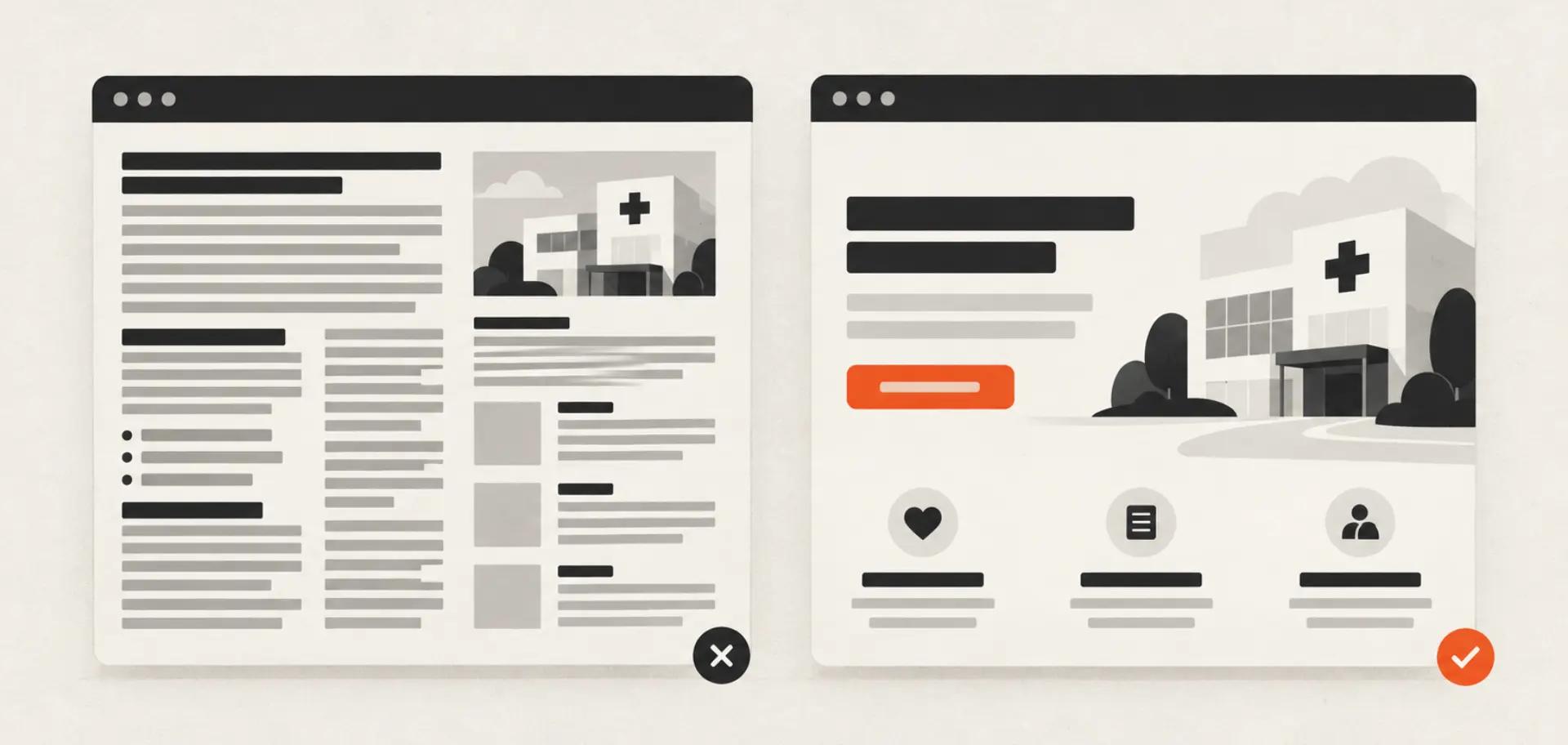
A clinic can have an experienced medical team and clearly defined services. But if patients cannot understand what they read on the website, it is harder for them to see why they should choose that clinic.
Medical jargon becomes a barrier when terms that are familiar to specialists remain unexplained for people looking for a service. Every unfamiliar word asks patients to do extra work: guess, search or ask someone to explain.
Medical language can add friction to conversion when it makes information difficult to use. We cannot attribute every misunderstood term to a lost patient. We can, however, identify and reduce a point of friction that appears before booking.
What medical jargon means for patients
In the consultation room, specialist terms help clinicians communicate precisely. On a service page, in an advert or in a confirmation message, the same terms can make information harder to follow when they appear without context.
A study published in JAMA Network Open assessed how 215 adults without medical training understood common medical phrases. In the researchers’ comparisons, jargon-free wording was understood significantly better. Some medical phrases were misunderstood, sometimes with the opposite meaning to what was intended. The study did not examine clinic bookings and was not conducted in Romania.
A systematic review of medication-label instructions also identified plain language as a factor that can support understanding; abbreviations and jargon made interpretation harder in the studies reviewed. This evidence concerns medication instructions, not marketing pages. Read the review in PLOS ONE.
These findings support an important principle for clinic communication: wording matters. They do not directly prove that removing jargon increases booking rates or revenue.
Where the jargon tax appears in clinic communication
Patients may encounter medical terms before speaking with a clinician: on the website, in adverts, in forms, at reception or in messages sent after a consultation.
A page may list a procedure, test or material without explaining what it involves or why it might be relevant. The information is there, but patients have to interpret it on their own.
At that point, some people look elsewhere for an explanation or contact the clinic. Others may delay their decision. We cannot know automatically which of these things has happened; we need to review the questions patients ask and their actual behaviour.
Clarity without oversimplification
The answer is not to remove every medical term. The exact name can matter to patients and to their conversation with a clinician. The goal is to keep the precision and explain the term in everyday language.
For example, instead of writing only “endodontic treatment”, a clinic could write “root canal treatment (endodontic treatment), which treats the inside of the tooth”. The exact wording should be checked by the clinician responsible for the service.
A useful explanation can answer three questions: what the term means, what the service involves in broad terms and what happens next. It should not replace medical assessment or suggest that the same option is suitable for every patient.
Clear language does not mean superficial information. A clinic can communicate expertise through precision, context, the team’s experience and transparent boundaries, rather than relying only on technical vocabulary.
How to identify terms that may confuse patients
Start with pages that directly affect a patient’s decision: promoted services, landing pages used in adverts and booking forms. Read them as someone who has never used the service before.
List terms and abbreviations patients may not know. Check whether an explanation appears next to each term, whether the text shows what the service involves and whether the next step is easy to find.
Then ask someone without medical training to read the page and explain, in their own words, what they understood. If their answers differ significantly from what the clinic intended, review the text with the clinician.
How to test whether the language works
Do not assume that simpler wording will automatically increase bookings. Compare versions and monitor signals that show whether the information is easier to use: questions asked at reception, clarification requests, clicks towards booking, and forms started and completed.
Keep the offer and page as consistent as possible during the comparison. If you change the text, design and offer at the same time, you will not know which change influenced the result. Review the quality of enquiries as well as their number.
Testing is not meant to turn medical communication into a slogan. It is meant to show whether patients understand the information better and can decide more easily what the right next step is for them.
Clinic language is part of the patient experience
The patient experience starts before the consultation: when someone searches for a service, compares clinics and tries to understand what each option involves. Website clarity should continue in adverts, at reception and in communication after the consultation.
In our article about the patient experience during a consultation we explain why clarity and next steps matter after the conversation in the treatment room.
At Digital Interaction, the website, content, campaigns, reception and follow-up are parts of the same journey. Language is therefore more than tone: it is one of the ways patients understand a clinic’s offer and move towards the next step.
Want to find where communication barriers appear in your clinic? Talk to Digital Interaction about your medical marketing strategy and patient conversion journey.
Sources
Yan et al., “Accuracy in Patient Understanding of Common Medical Phrases,” JAMA Network Open.
Maghroudi et al., “The impact of textual elements on the comprehensibility of drug label instructions: A systematic review,” PLOS ONE.