

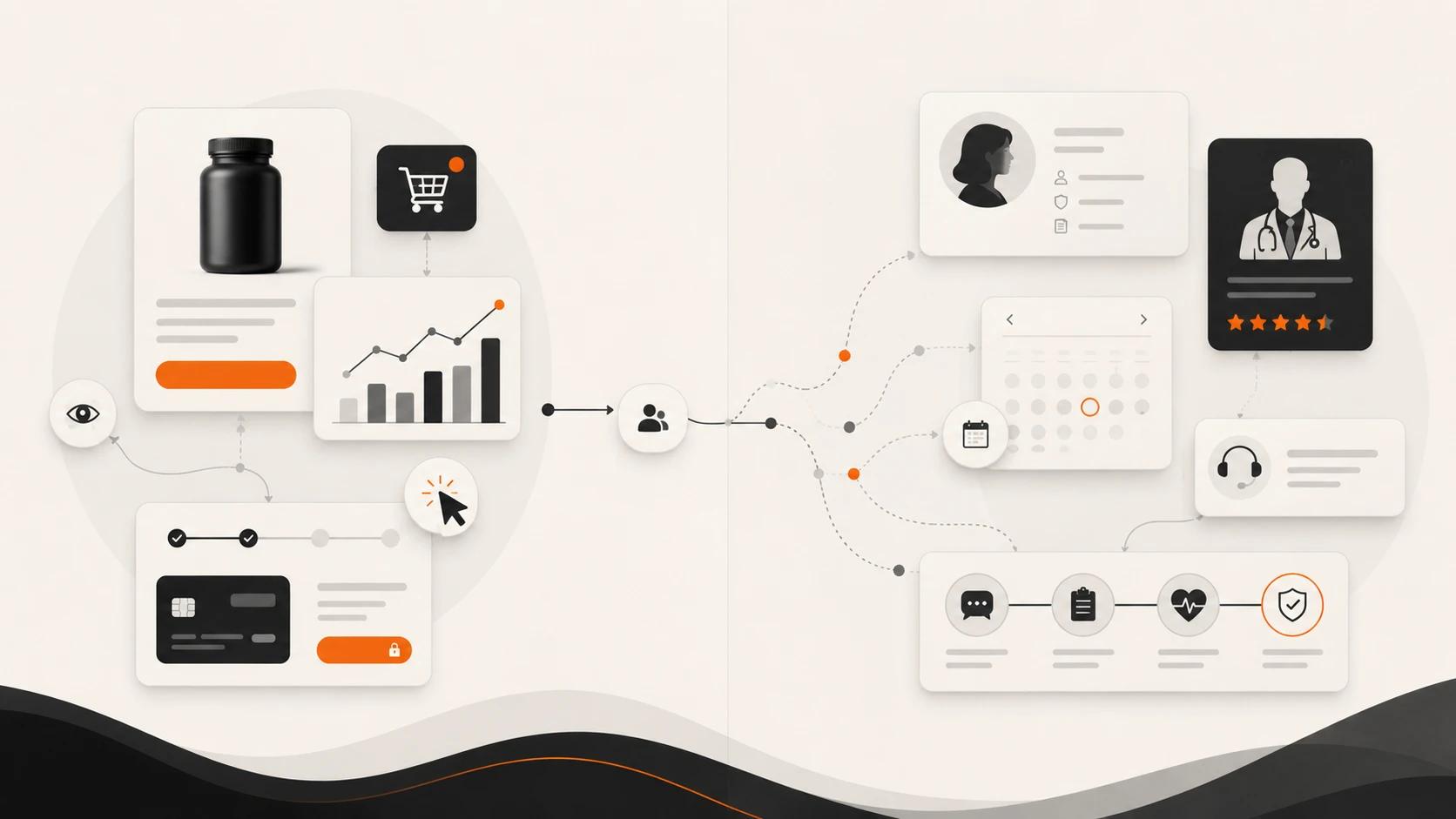
Why a Clinic Cannot Be Marketed Like an Online Store
There is a fundamental reason why a clinic cannot be marketed like any other business.
In general marketing, the objective is usually to persuade a customer to purchase a product or service. In medical marketing, the objective is to persuade a patient to entrust their health to a clinic and a doctor.
This difference changes the entire process.
A patient is not making a simple purchasing decision. They may feel that they are taking a risk involving their health, comfort, physical appearance, privacy, or safety. They need more information, check multiple sources, and may postpone the decision for weeks or even months.
Moreover, the conversion process does not end when the patient submits a form. The enquiry must be handled by the reception team, converted into an appointment, confirmed, attended, and, in some cases, transformed into an accepted treatment plan.
This is why medical marketing is not general marketing with a doctor added to the picture.
It is a distinct discipline that combines promotion, education, reputation, patient experience, clinic processes, and the measurement of results generated both online and offline.
Want to find out where patients are being lost between the advertisement, the appointment, and the treatment? Talk to us about your clinic’s marketing strategy.
Below, we examine the 36 differences between an agency specialising in medical marketing and a generalist agency.
1. Medical marketing is not general marketing with different visuals
The most common mistake is treating a clinic like an ordinary business.
The same tactics, messages, and conversion strategy are retained, while the product is replaced with a medical procedure. The advertisement features a doctor, an image of the clinic, and an appointment button.
But the difference is not visual.
Medical marketing is different because:
- the decision carries higher stakes;
- the patient is in a vulnerable position;
- the required level of trust is higher;
- the conversion process is longer;
- a significant part of the conversion happens offline;
- communication is subject to stricter rules.
A clinic treated like an online store may generate traffic and leads while still losing appointments, patients, and revenue during the later stages of the process.
2. A consumer makes a purchase. A patient takes a risk
When purchasing an ordinary product, a consumer mainly risks money and time.
If they do not like the product, they can return it or decide not to purchase from that brand again.
In healthcare, the perceived risk is significantly higher.
A patient may feel that they are putting at risk:
- their health;
- their physical appearance;
- their comfort;
- their privacy;
- their ability to function;
- sometimes even their life.
For this reason, an attractive offer alone is not enough to convince a patient.
They need to believe that the doctor is competent, that the diagnosis will be accurate, that the procedure is appropriate, and that they will be treated responsibly.
In general marketing, you need to persuade a customer to buy.
In medical marketing, you need to persuade a patient to trust.
3. Medical marketing captures existing demand
Marketing can create desire for a new product, a holiday, or an item of clothing.
In healthcare, however, it should not artificially create the need for an intervention.
You cannot and should not convince a healthy person that they need surgery simply because the clinic has available capacity.
The role of medical marketing is to:
- help the patient recognise a problem;
- explain symptoms and available options;
- show when a consultation may be necessary;
- demonstrate why the clinic may be the right choice;
- earn the patient’s preference over other providers.
Medical marketing primarily competes for a share of existing demand.
The patient already has a need, a problem, a concern, or an objective. The clinic must become their preferred choice through information, trust, and relevance.
4. General marketing begins with desire. Medical marketing begins with need
Many commercial campaigns begin with pleasure, status, comfort, curiosity, impulse, or the desire to try something new. Medical campaigns, by contrast, frequently begin with pain, discomfort, fear, prevention, loss of function, health concerns, or dissatisfaction with one’s physical appearance.
The patient is not looking for entertainment. They are looking for clarity, reassurance, and answers that help them understand what is happening and what their next step should be.
This is why messages that work for consumer products can appear superficial or inappropriate when applied to medical services. A specialised agency must understand the patient’s state of mind when they encounter the message and identify the information that can reduce uncertainty and help them make an informed decision.
5. The patient is in a different emotional state
A patient may encounter a medical message while feeling frightened, confused, embarrassed, vulnerable, in pain, distrustful, or disappointed after a previous experience. This emotional state directly influences how they interpret advertisements, written content, and interactions with clinic staff.
An overly aggressive message may be perceived as lacking empathy, an alarmist message may increase anxiety, and an excessively technical message may create even more confusion.
Medical communication should provide the patient with a sense of control, predictability, clear explanations, understandable next steps, and the confidence that they can make an informed decision safely.
Medical marketing should not exploit the patient’s vulnerability. It should address it with responsibility, empathy, and respect.
6. The tone must convey empathetic authority, not hype
General consumer brands can use humour, sarcasm, exaggeration, and highly provocative messaging.
In healthcare, the tone should remain:
- professional;
- warm;
- clear;
- educational;
- reassuring;
- confident without appearing arrogant.
The doctor should be presented as an expert who understands the patient’s problem, not as a salesperson attempting to close a transaction.
Communication must convey two things at the same time:
The clinic has the necessary expertise.
The patient will be listened to and treated with empathy.
Too much authority without empathy can create distance.
Too much warmth without evidence of competence can reduce credibility.
Achieving the right balance between the two is one of the defining characteristics of medical marketing.
7. Ethics, professional standards, and legislation limit commercial tactics
Tactics used in e-commerce cannot automatically be transferred to healthcare. Communication for medical services should avoid absolute guarantees, promises that all patients will achieve identical results, unsupported medical claims, disparaging comparisons, unjustified commercial pressure, the trivialisation of medical care, the exploitation of fear, and the presentation of a procedure as a universal solution.
Marketing must comply with applicable legislation, professional standards, and the policies of advertising platforms.
A generalist agency may assess a claim primarily according to its ability to attract attention and increase the conversion rate. A specialised agency must also assess whether the message is responsible, substantiated, permitted, and appropriate for the medical context.
8. Meta and Google have stricter rules for healthcare advertising
Advertising platforms apply greater scrutiny to healthcare-related advertisements.
Restrictions may apply to:
- personal attributes;
- wording that implies the user has a particular condition;
- certain before-and-after images;
- sensitive content;
- medical procedures;
- targeting;
- remarketing;
- landing pages.
A phrase such as “Are you suffering from this condition?” may create problems because it assumes sensitive information about the user.
Similarly, images that work in the beauty or fitness industries may be considered too graphic, intrusive, or non-compliant in a medical context.
A specialised agency must understand these restrictions during the strategy and creative development stages, not only after advertisements have been rejected.
9. Retargeting must respect patient privacy
Retargeting is a common marketing tactic.
A user visits a page and later sees advertisements related to the product they viewed.
In healthcare, this tactic must be used with greater discretion.
A person’s interest in a condition, investigation, or treatment may be sensitive. The patient’s device may be seen by:
- their partner;
- family members;
- colleagues;
- friends;
- other people.
An overly explicit advertisement may unnecessarily reveal the patient’s interest in a medical issue.
For this reason, retargeting messages should be discreet, general, and designed to protect the user’s privacy.
Confidentiality is not merely a legal concern. It is a component of the marketing strategy.
10. The decision-making process is longer
An ordinary purchase can take place within a few minutes. Choosing a medical treatment, by contrast, often involves a more complex process that may include research, comparisons between clinics, verification of the doctor’s experience, review analysis, discussions with family members, cost evaluation, confirmation of the diagnosis, and even multiple consultations.
A patient may see an advertisement today and contact the clinic several weeks later. For complex treatments, the process of gathering information and building trust may take several months.
For this reason, a medical campaign should not be evaluated exclusively on immediate results. The agency must monitor the patient’s entire journey, including the time between the first interaction and the enquiry, the interval between the enquiry and the consultation, the period between the consultation and the start of treatment, the patient’s return, and the intermediate interactions that contribute to the final decision.
11. The patient researches the clinic across multiple sources
After seeing an advertisement, a patient may:
- search for the clinic’s name;
- check the doctor’s profile;
- read reviews;
- watch videos;
- assess the technology used;
- visit the website;
- ask for recommendations;
- compare other clinics.
The campaign does not operate in isolation.
It is part of an ecosystem in which every touchpoint must support the same promise.
If the advertisement communicates a premium experience but the website appears outdated, there is a disconnect.
If the advertisement highlights empathy but the reviews mention poor communication, trust decreases.
If the doctor is presented as an expert but no information is available about their experience, the patient may continue searching.
Medical marketing requires consistency across all the sources a patient may consult.
12. The patient does not always search for the procedure
A patient may not know the name of the treatment they might need. In many cases, they can identify only the symptom, the pain, the change they have noticed, the discomfort, or the loss of function.
For example, they may search for “my tooth hurts when I bite,” rather than “root canal treatment,” or “my teeth are becoming loose,” rather than “periodontal treatment.”
For this reason, medical content must cover the patient’s entire informational journey, from the symptom and possible causes to the point at which a consultation is recommended, the necessary investigations, the diagnosis, treatment options, recovery, and prevention.
A generalist agency usually focuses on promoting the service. An agency specialising in medical marketing must also understand the earlier stage, when the patient knows they have a problem but does not yet know which service or treatment to search for.
13. The patient and the decision-maker may be different people
The person receiving treatment is not always the person searching for the clinic or making the final decision. In some situations, a parent chooses a paediatrician, an adult child searches for a care centre for an elderly parent, a partner influences the decision regarding an expensive intervention, a family evaluates a complex operation, or a caregiver manages the appointment and payment.
In such cases, communication must address not only the patient’s needs but also the concerns of the person supporting them through the decision-making process. This person may be looking for information about safety, communication, transparency, continuity of care, costs, availability, and how the overall medical experience will be managed.
Marketing must speak both to the patient and to the people helping them understand the options, evaluate the risks, and make a decision.
14. The doctor is part of the service and the brand
The patient does not choose only the building, the technology, or the equipment.
They also choose the person they are going to trust.
Important factors include:
- the doctor’s experience;
- their specialisation;
- their qualifications and expertise;
- the way they explain information;
- their empathy;
- their professional reputation;
- their presence in video content;
- the way they answer questions.
Content featuring the doctor can begin building the relationship before the consultation.
A video in which the doctor explains a procedure in simple terms can reduce anxiety and give the patient an initial impression of their communication style.
A medical marketing agency should not treat the doctor as merely an image used in advertisements.
It should transform the doctor’s expertise into a trust-building asset for the clinic.
15. Education is a legitimate commercial component
Effective medical marketing educates the patient through content that explains symptoms, possible causes, necessary investigations, treatment options, procedural stages, risks, recovery, prevention, and eligibility criteria.
Education does not replace a consultation and does not establish a diagnosis. Its role is to reduce uncertainty and help the patient understand when and why they should request a medical evaluation.
A better-informed patient can ask more relevant questions, understand the doctor’s recommendations more easily, develop more realistic expectations, and make a more responsible decision.
In healthcare, educational content is not separate from the commercial process. It is one of the most credible ways to build trust before the consultation.
16. Prevention plays a more important role
A clinic’s marketing should not appear only when the patient has an emergency.
It can help build habits related to:
- regular check-ups;
- screening;
- professional cleaning;
- investigations;
- monitoring existing conditions;
- early detection.
Through consistent content and communication, the clinic can become a trusted source of information before a crisis develops.
This approach supports both the patient’s health and the clinic’s sustainable growth.
Marketing based exclusively on emergencies appears too late.
Marketing that also focuses on prevention builds a relationship before the patient needs a complex intervention.
17. Price is a filter, not the primary argument
Price is important because it directly affects the patient’s ability to proceed with treatment. However, a lower price does not demonstrate that the recommended solution is appropriate, safe, properly planned, correctly performed, or supported by monitoring after the intervention.
For significant medical services, trust may matter more than the price difference between two clinics. Communication should therefore explain the value of the treatment through the doctor’s experience, the quality of the diagnosis, the materials used, the available technology, the attention given to planning, the predictability of the outcome, post-treatment care, and cost transparency.
An agency specialising in medical marketing should not avoid discussing price entirely, but neither should it turn price into the main or only reason for choosing the clinic.
18. Discounts can reduce trust
Aggressive promotions can work extremely well for consumer products.
In healthcare, they can raise questions such as:
- Why is the procedure so inexpensive?
- Has the quality been compromised?
- Are all stages included?
- Are the same materials being used?
- Is the treatment medically recommended or simply being sold?
A poorly presented discount can turn a commercial advantage into a reason for distrust.
A medical offer should instead be built around:
- access to an evaluation;
- transparency;
- a clearly defined package;
- payment options;
- genuine benefits;
- the value provided.
The objective is not to make the treatment appear cheap, but to make the decision clearer and more accessible.
19. Scarcity and urgency must be used responsibly
Messages such as “only three places left” or “discount available today only” are common in general marketing.
In healthcare, they can trivialise the decision and create unjustified pressure.
Urgency must be genuine.
It may relate to:
- the doctor’s availability;
- the appointment schedule;
- a defined evaluation period;
- a limited programme;
- the medical risk of postponement, explained responsibly.
Marketing should not manufacture pressure in order to force consent.
The patient should feel that they have the information and time needed to make a decision, except in situations involving a genuine medical emergency.
20. Reputation is part of the funnel
An advertisement may generate initial interest, but the clinic’s reputation determines whether the patient continues the decision-making process. At this stage, the clinic’s rating, the number and recency of reviews, the way responses are managed, the experiences described by other patients, doctor profiles, presented outcomes, and the consistency of the information available online all matter.
After seeing an advertisement, the patient may immediately search for the clinic on Google to determine whether the promise made in the campaign is supported by other people’s real experiences. If they find unanswered negative reviews, incomplete information, outdated details, or discrepancies between the advertisement and the clinic’s online presence, their interest may disappear quickly.
A weak reputation increases the cost of every campaign because the agency must generate more clicks and enquiries to achieve the same number of patients who book and attend appointments.
21. Medical marketing is hyperlocal
Most clinics serve a clearly defined geographical area, and the patient’s decision is influenced by practical factors such as distance, travel time, accessibility, parking, proximity to home or work, transport options, and the clinic’s opening hours.
For this reason, visibility through Google Business Profile and Google Maps, local reviews, pages optimised for the city or service area, visibility in “near me” searches, and accurate opening hours and contact details are essential parts of the strategy.
A smaller audience located near the clinic and demonstrating genuine appointment intent can be far more valuable than a large national audience. Local marketing is not merely a targeting option within advertising platforms. It is a central part of how the clinic attracts relevant patients.
22. Every service involves a different intent
Emergencies, prevention, and elective treatments cannot be marketed in the same way because each begins with a different patient intent.
In an emergency, the patient is primarily looking for availability, proximity, a rapid response, the ability to call immediately, and simple information that allows them to act without delay.
High-value treatments usually involve a longer decision-making process. They require education, medical authority, the presentation of relevant cases, reputation, detailed explanations, payment options, and multiple interactions before the patient makes a decision.
Prevention works differently because it requires recurring communication, educational content, reminders, and the gradual development of a habit.
A generalist agency may organise campaigns solely around the services being promoted. An agency specialising in medical marketing must build them around the patient’s intent, level of urgency, and actual decision-making process.
23. More leads do not necessarily mean more patients
A lead represents only the beginning of the process. To evaluate its real value, the clinic must determine whether the person responds, needs the promoted service, is eligible, can afford the treatment, wants to book, attends the consultation, and accepts the recommended plan.
A high volume of leads can even reduce campaign efficiency when the enquiries are poorly qualified. The reception team may become overwhelmed by people with little genuine intent, while relevant patients may receive a late response or be lost during the process.
For this reason, a campaign generating 30 relevant leads may produce more revenue than one generating 100 inexpensive enquiries with low booking and attendance rates.
In medical marketing, lead quality should not be evaluated only when the form is submitted. It must be assessed through the results those leads generate later in the process.
24. The real KPI is an attended appointment
A submitted form does not automatically generate revenue, and an appointment added to the calendar does not guarantee that the patient will attend or accept the recommended treatment.
To assess performance correctly, the entire journey must be monitored, from contacted and qualified leads through bookings, confirmations, attended appointments, consultations, accepted treatments, and generated revenue.
The complete process can be represented as follows:
Advertisement → lead → contacted → qualified → booked → confirmed → attended → consulted → treatment accepted → revenue
Cost per lead remains a useful indicator, but it is not enough to demonstrate the true effectiveness of a campaign. A medical marketing agency should be able to analyse cost per appointment, cost per attended patient, treatment acceptance rate, patient acquisition cost, generated revenue, and profitability.
Performance should be connected to the clinic’s real outcomes, not evaluated solely through the data displayed in advertising platforms.
25. The medical funnel is partly invisible online
In e-commerce, the click and the payment usually take place within the same system.
In healthcare, important stages may take place:
- over the phone;
- on WhatsApp;
- at reception;
- inside the consultation room;
- within the clinic’s medical software;
- through a bank transfer;
- through instalment payments.
A real patient journey may look like this:
Advertisement → article → Google search → reviews → phone call → appointment → consultation → treatment plan → payment
If the agency sees only the form submission, it cannot identify which campaigns are generating profitable patients.
It may optimise campaigns for inexpensive leads who never attend and discontinue campaigns that generate fewer enquiries but higher-value treatments.
Medical marketing requires online data to be connected with offline outcomes.
26. Attribution is more difficult
A patient may see an advertisement without clicking it, later search for the clinic’s name, call directly, return through Google Maps, ask for a recommendation, submit the form from another device, or contact the clinic several weeks later.
For this reason, the last click does not always tell the full story and does not completely reflect the contribution of each channel to the patient’s decision.
More accurate attribution can be supported by tools and processes such as call tracking, a CRM, source fields in enquiry forms, questions asked by the reception team, the identification of patients who attended, the attribution of revenue to the original source, and analysis of the journey across multiple channels.
A medical marketing agency must accept that perfect attribution is difficult while still building a measurement system that is more relevant than simply reporting the conversions displayed by advertising platforms.
27. The reception team is part of the conversion system
In e-commerce, a user can complete a purchase without any human interaction.
In healthcare, the reception team can determine whether an enquiry becomes an appointment.
Important factors include:
- response time;
- tone of voice;
- empathy;
- the qualification process;
- the way price is discussed;
- follow-up;
- confirmations;
- rescheduling;
- missed calls.
The advertisement may work perfectly while the revenue is lost during the phone call.
If the patient receives a cold response, is contacted too late, or is given only a price without any context, they may choose another clinic.
In medical marketing, the reception team performs a function similar to the checkout page in e-commerce.
If this stage does not work, the advertising budget will not be converted into revenue.
28. The offline experience validates the online promise
Marketing creates a particular expectation in the patient’s mind, and the clinic must confirm it through the real experience. Punctuality, cleanliness, communication, empathy, clear explanations, transparency, comfort, and post-treatment care must support the promise created online.
If the website communicates a premium experience but the patient waits for a long time, receives no explanations, or feels that they are treated superficially, a disconnect emerges between the brand’s image and the reality inside the clinic.
A poor experience inevitably feeds back into marketing through negative reviews, lost referrals, cancellations, lower retention, and higher acquisition costs.
Marketing does not end when the patient enters the clinic. Everything that happens afterwards can strengthen or destroy the promise created online.
29. Optimisation is slower
In some industries, the financial result appears immediately after the click.
In healthcare, revenue may appear weeks or months later.
The agency must account for:
- the duration of the decision-making process;
- the time until the consultation;
- the time until treatment begins;
- necessary investigations;
- multiple visits;
- instalment payments;
- the clinic’s capacity.
A campaign should not be assessed only on its first few days of performance.
At the same time, patience does not mean operating without measurable indicators.
The agency must monitor intermediate stages such as:
- lead quality;
- contact rate;
- appointment rate;
- show rate;
- estimated case value;
- progress towards treatment.
Optimisation is slower, but it must remain disciplined.
30. Operational capacity influences marketing
A campaign should not generate more demand than the clinic can realistically process. The strategy must reflect the number of available doctors, the reception team’s capacity, response time, appointment availability, priority services, service margins, and average case value.
If a doctor can see only a few new patients each week, a campaign focused exclusively on volume may create long waiting times, frustration, and the loss of relevant enquiries.
For this reason, marketing must be aligned with the clinic’s actual objectives and operational capacity. Generating demand is not enough. The clinic must attract the right volume of patients, for the right services, at the right times, and within the limits of its available resources.
31. Patient value changes the economics of acquisition
A patient may generate value for the clinic not only through the initial consultation, but also through investigations, treatment, regular check-ups, preventive services, complementary services, treatments recommended to family members, and referrals to other people.
For this reason, acquisition cost should not be compared exclusively with the value of the first consultation. A clinic may be able to accept a higher cost to acquire a patient when it understands the real value that patient can generate over time.
This analysis requires data regarding average case value, frequency of return visits, complementary services accessed, referrals generated, and retention levels.
A generalist agency may optimise campaigns solely according to the cost of the initial conversion. A medical marketing agency must understand the full economics of the patient and evaluate performance according to the total value generated, not only the first interaction.
32. The healing paradox changes the retention strategy
In many industries, the objective is for the customer to purchase as frequently as possible.
In medicine, the purpose of treatment is to resolve the problem.
The clinic should not create dependency or artificially invent new needs.
Retention must be built ethically through:
- prevention;
- monitoring;
- continuity of care;
- relevant check-ups;
- necessary medical services;
- education.
The patient may return because they need monitoring or preventive care, not because marketing is attempting to keep the original problem active.
This paradox makes medical retention fundamentally different from traditional commercial retention.
33. Post-treatment care is marketing
A phone call or message sent after an intervention can have more value than a promotion. Follow-up demonstrates care, professionalism, responsibility, continuity, and a genuine interest in the patient’s recovery.
Post-treatment care can reduce anxiety, help identify potential problems quickly, improve satisfaction, and strengthen the relationship between the patient and the clinic. At the same time, a positive post-treatment experience can generate more reviews and referrals.
Marketing is not only about attracting new people. The experience provided to existing patients can become one of the clinic’s most powerful growth drivers.
34. Referrals are a growth channel
When health is at stake, people place greater weight on personal recommendations.
Marketing can amplify referrals through:
- a positive experience;
- review requests;
- easily shareable content;
- post-treatment communication;
- long-term relationships;
- continuity of care.
Paid campaigns and referrals are not entirely separate channels.
A patient may receive a recommendation and then research the clinic online.
They may see an advertisement and then ask a friend for their opinion.
They may discover a doctor through content and then receive confirmation from someone they trust.
Advertising, reputation, and referrals should reinforce one another.
35. Medical marketing cannot be evaluated through vanity metrics
Reach, views, clicks, and engagement can be useful indicators for understanding whether a message attracts attention and generates interest. However, they do not represent the final outcome of medical marketing.
A video may accumulate a large number of views without generating appointments, a campaign may attract inexpensive leads who never respond, and an article may generate traffic from outside the clinic’s service area.
Real performance must be evaluated through the number of suitable patients attracted, the appointments they actually attend, the consultations completed, the treatments accepted, the revenue generated, patient retention, and referrals.
Vanity metrics can indicate whether the message works at the attention level, but results must ultimately be evaluated according to marketing’s genuine contribution to the clinic’s activity and profitability.
36. A clinic needs a system, not just a campaign
Advertisements represent only the patient acquisition layer.
Complete medical marketing must connect:
- patient acquisition;
- the website;
- content;
- reputation;
- doctors;
- enquiry forms;
- the reception team;
- appointment booking;
- consultations;
- treatment;
- retention;
- measurement.
An agency that optimises only the advertisements sees only a small part of the problem.
It may increase the number of enquiries without being able to explain why they do not become patients.
It may reduce the cost per lead without being able to demonstrate how much revenue was generated.
It may increase traffic without being able to compensate for a weak reputation or a flawed enquiry-handling process.
A clinic does not need only an isolated campaign.
It needs a conversion architecture that connects the patient’s first interaction with the actual outcome generated for the clinic.
Generalist Agency vs. Medical Marketing Agency
A generalist agency usually optimises the cost and volume of leads, while an agency specialising in medical marketing monitors how many of those leads become patients who book and attend appointments.
While a generalist agency focuses on promoting the service, a medical marketing agency covers the patient’s entire journey, from identifying a symptom and searching for information to attending a consultation and beginning treatment.
Standard commercial tactics are replaced or adapted according to the level of trust required, the patient’s vulnerability, medical ethics, and the communication limitations specific to healthcare.
A generalist agency may primarily track the conversions recorded by advertising platforms, while a medical marketing agency connects online data with calls, appointments, attended visits, consultations, and revenue generated offline.
Evaluation does not end with the cost per lead. It continues with the analysis of cost per appointment, cost per attended patient, and cost per accepted treatment. Rather than focusing exclusively on campaigns, a medical marketing agency analyses the complete conversion system, including the website, reputation, reception team, and patient experience inside the clinic.
The objective is not to maximise volume at any cost, but to align demand with patient eligibility and the clinic’s actual resources. Services are not marketed identically. They are differentiated according to the patient’s intent, level of urgency, and decision-making process.
The reception team is not treated as entirely separate from marketing because response time, communication, and follow-up directly influence the conversion of enquiries into appointments.
Therefore, while a generalist agency may report traffic, clicks, and leads, an agency specialising in medical marketing monitors attended appointments, accepted treatments, revenue, and the profitability generated for the clinic.
Can a Generalist Agency Market a Clinic?
Yes, provided that it adapts its processes and understands the specific characteristics of healthcare.
A generalist agency may have excellent expertise in:
- Google Ads;
- Meta Ads;
- SEO;
- branding;
- content creation;
- web development;
- data analysis.
The problem is not a lack of technical expertise.
The problem appears when those skills are applied without understanding:
- patient psychology;
- the role of trust;
- communication limitations;
- the longer decision-making process;
- the reception team;
- reputation;
- offline conversions;
- the patient’s real value.
An agency can learn these particularities.
However, until it integrates them into its strategy, it remains a generalist agency marketing a medical business, rather than an agency specialising in medical marketing.
How to Choose a Medical Marketing Agency
Before selecting a partner, check whether the agency asks questions about the clinic’s entire operation, not only its advertising budget.
Relevant questions include:
- Which services are the priority?
- What is the average case value?
- How many enquiries can the reception team process?
- How quickly are leads contacted?
- What is the appointment booking rate?
- What is the appointment attendance rate?
- What is the treatment acceptance rate?
- How are patient sources tracked?
- What are the main reasons patients decline?
- What availability do the doctors have?
- Which services have the strongest margins?
- How are appointments confirmed?
- How are missed calls handled?
An agency that asks only about the clinic’s budget and desired number of leads sees only part of the problem.
Conclusion
There is an essential difference between persuading a customer to purchase and persuading a patient to trust.
Medical marketing is different because:
- the patient takes a greater risk;
- the required level of trust is higher;
- the decision-making process is longer;
- reputation directly influences conversion;
- the doctor is part of the brand;
- a significant part of the funnel takes place offline;
- the reception team influences campaign outcomes;
- performance must be connected to treatments and revenue;
- communication is subject to stricter rules.
A clinic does not simply need more submitted forms.
It needs the right patients: people who are contacted promptly, book appointments, attend, trust the medical team, and accept the treatments they genuinely need.
At Digital Interaction, we define this approach through the concept of Conversion Architecture.
We do not optimise advertisements in isolation. We connect promotion with the website, content, reputation, reception, appointment booking, and the clinic’s real results.
Because effective medical marketing is not only about campaigns.
It is about building a complete growth system.
If you would like us to identify where opportunities are being lost between the advertisement, the appointment, and the treatment, talk to us about your clinic’s marketing strategy.