

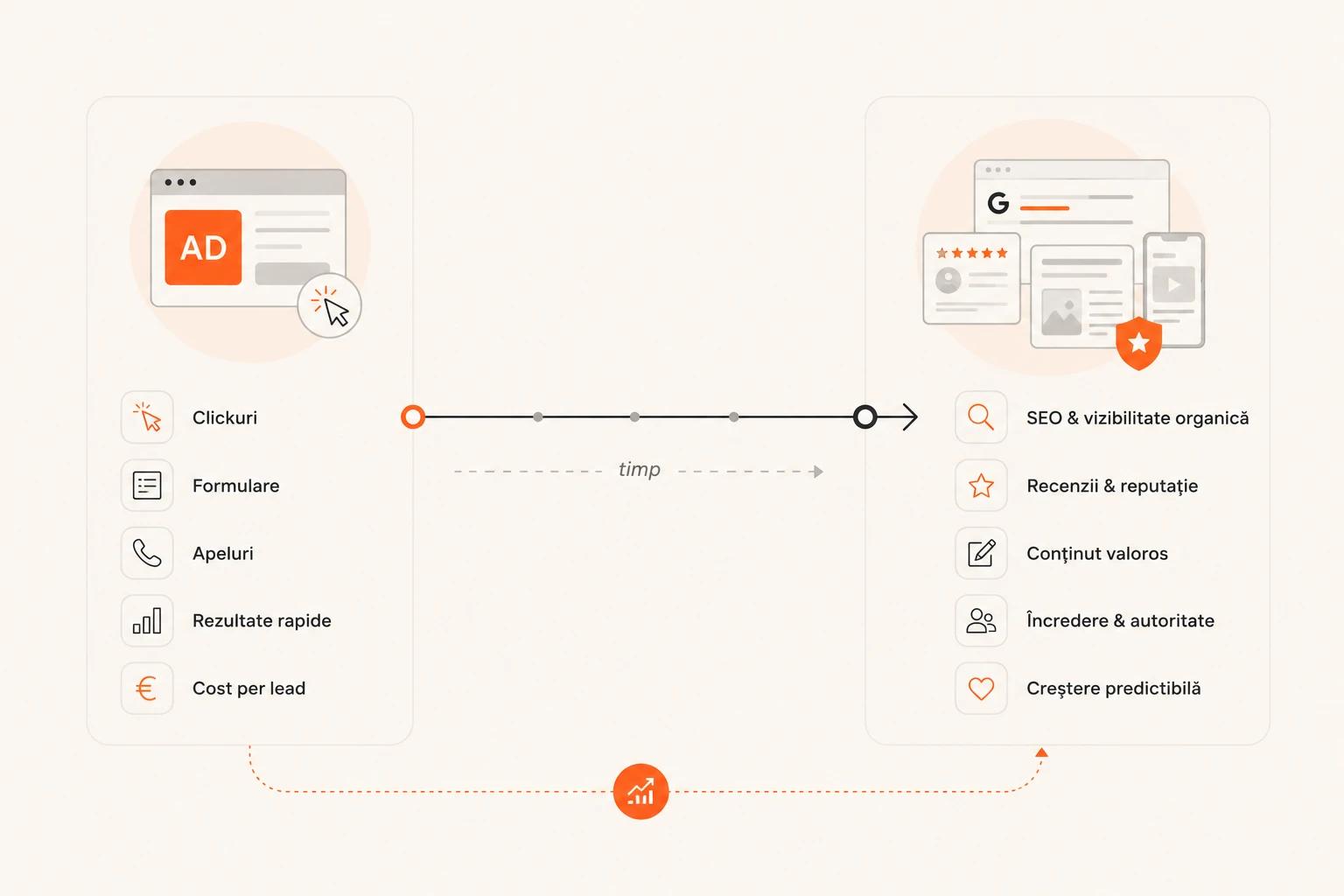
Short-Term vs. Long-Term Medical Marketing: Why Ads Are Not Enough
When you invest in marketing for your clinic, it is natural to want results as quickly as possible.
You want to know how much you invested, how many enquiries you received, how many appointments were booked, and how much revenue the campaign generated.
The problem begins when you try to assess your entire marketing strategy based only on the results produced within one or two months.
In healthcare, short-term marketing can generate enquiries quickly. However, it cannot build the trust, reputation, and predictability your clinic needs to grow consistently.
An ad can help a patient discover you.
It is rarely enough to make them choose you.
Is your clinic generating leads but not enough patients?
We analyse the entire patient journey, from the first ad to the appointment, attendance, and treatment acceptance, to identify where results are being lost.
What short-term medical marketing means
Short-term marketing includes the actions that can generate traffic and enquiries almost immediately.
The most common examples are Meta Ads and Google Ads campaigns.
Within a few days, you can see how many people clicked on an ad, how many completed a form, and how much each enquiry cost.
This makes short-term marketing relatively easy to monitor.
You invested €2,000 and received 100 enquiries. The platform reports a cost of €20 per enquiry.
However, an enquiry is not the same thing as a patient.
That person may not answer the phone, may only ask about the price, may compare several clinics, or may not yet be ready to begin treatment. They may not have the necessary budget, may book an appointment and fail to attend, or may attend the consultation without accepting the treatment plan.
For this reason, cost per lead does not tell you whether your marketing is profitable.
It only tells you how much you paid for an opportunity.
The real result appears when the person books an appointment, attends it, accepts the treatment, and generates revenue for the clinic.
Short-term marketing brings attention, not automatic trust
In other industries, a strong offer and a persuasive ad can produce a quick purchase.
In healthcare, the decision is more complex.
The patient is not simply buying a service. They are accepting a risk related to their health, appearance, or comfort.
Before choosing, the patient wants to know who the doctor is, how much experience they have, what results they have achieved, what other patients say about them, what the clinic looks like, and how clearly the treatment is explained. At the same time, they want to feel that they can trust the team and understand whether the price is justified.
For a dental cleaning, consultation, or emergency appointment, the decision may be relatively quick.
For a dental implant, rhinoplasty, orthodontic treatment, or surgical procedure, the decision-making process may take weeks or months.
The patient may see your ad today, visit the doctor’s profile a few days later, read your reviews a month from now, and request an appointment only after encountering your clinic several times online.
The campaign started the process.
It did not complete it on its own.
What medium- and long-term medical marketing means
Medium- and long-term marketing builds assets that continue working for your clinic after a campaign has ended.
This includes the clinic’s positioning, the reputation of its doctors, Google reviews, SEO and organic visibility, educational content, a consistent social media presence, documented case studies and results, the experience provided by the website, communication with existing patients, referrals, and follow-up and reactivation messages.
These actions do not always produce spectacular results in the first month.
Instead, they gradually reduce the patient’s resistance.
When someone sees your name several times, finds clear answers on your website, reads credible reviews, and sees real results, they no longer begin from zero when they speak to your reception team.
They already arrive with a certain level of trust.
That trust can improve your response rate, appointment-booking rate, attendance rate, treatment acceptance rate, average patient value, and number of referrals.
Long-term marketing does not replace campaigns.
It makes them more effective.
Are your campaigns disconnected from the rest of your marketing?
We help you build a strategy in which advertising, SEO, content, and your clinic’s reputation support the same objective: more appointments and more predictable growth.
Why long-term results are harder to see
A Meta or Google campaign gives you numbers quickly.
You can see the number of clicks, forms, and calls.
With SEO, content, or positioning, progress is more difficult to evaluate when you are a doctor who does not work in marketing every day.
You may receive an article from your agency, but you do not necessarily know whether it responds to a real search query, is correctly optimised, supports a profitable service, has a strong structure, can compete in Google results, guides the reader towards an appointment, or forms part of a broader strategy.
The same applies to social media.
The fact that a post looks good does not mean that it supports your positioning. At the same time, the fact that it does not generate direct appointments does not mean that it has no value.
Content can influence a decision without receiving credit for the final click.
A patient may discover your clinic on Instagram, later search for you on Google, read your reviews, and then call you directly.
In your report, the appointment may appear as organic traffic or a direct call.
That does not mean social media played no role.
It means the patient journey is not linear.
Why you need short-term results to invest for the long term
Long-term marketing should not be used as an excuse for a lack of results.
“We just need to wait longer” is not a strategy.
Your clinic has salaries, rent, equipment, and operating costs. You need revenue and clear signals that your investment is moving in the right direction.
This is why short-term marketing plays an essential role.
It gives you rapid feedback about market demand, information about the messages that attract patients, data about the services generating interest, and immediate revenue opportunities. At the same time, it allows you to test your offer and the entire appointment-booking process.
However, short-term performance must be interpreted in context.
If your campaigns are not profitable after three months, it does not automatically mean the agency has failed.
That may be the case.
However, there may also be other problems. Your reception team may respond too slowly, leads may not be followed up properly, the offer may not be competitive, the website may fail to inspire trust, the doctor may not be presented clearly enough, the clinic may have too few reviews, the price may be communicated without explaining the value, the promoted service may have a long decision cycle, or the local market may be highly competitive.
A campaign cannot compensate indefinitely for a system that loses patients after the first click.
What changes in a competitive market such as Bucharest
In a city with relatively few clinics, simply being visible may be enough to generate results.
In a market such as Bucharest, the patient may have dozens of options for the same service.
More clinics bid on the same searches. More doctors publish treatment results. More brands compete for the same attention.
This can lead to higher Google Ads costs, higher enquiry costs, more comparisons between clinics, slower decisions, a greater need for differentiation, and greater dependence on reputation and content.
In this situation, running a good ad is not enough.
The patient must understand why they should choose you.
The difference may come from the doctor’s experience, the technology used, the types of cases treated, the communication style, the experience inside the clinic, or a distinctive treatment method.
However, these differences must be made visible.
If you do not communicate them, your clinic will look similar to every other clinic from the patient’s perspective.
When every clinic appears to be the same, the decision almost inevitably shifts towards price.
Market demand is not unlimited
Marketing cannot create an unlimited number of patients for a service with limited demand.
Within a specific geographical area, there is a finite number of people who need the service, can afford the treatment, are ready to begin, live close enough to the clinic, and can be persuaded to choose a particular doctor.
When the number of clinics grows faster than demand, acquisition costs increase.
Under these conditions, even a well-managed campaign may become less profitable.
This does not necessarily happen because the advertising is poor. It happens because more clinics are competing for the same limited number of patients.
Your strategy should therefore not be limited to generating more leads.
You should also consider services with stronger demand, opportunities in new geographical areas, the clinic’s differentiation, patient retention, referrals, reactivation of your existing database, and increasing the value generated by each patient.
Sometimes the problem is not that you are generating too few enquiries.
The problem is that you are trying to purchase the same demand everyone else in the market is purchasing.
Why referrals are not enough
Many doctors grow during their early years through referrals.
A satisfied patient recommends a family member. A colleague recommends the clinic. A strong result becomes known within the right circle.
This mechanism is valuable, but it is not completely predictable.
You cannot control when a referral will appear, how many referrals you will receive, which services they will be interested in, how suitable the referred patient will be, or whether that person will eventually contact you.
Referrals are also influenced by what the patient finds online.
Even when someone receives a doctor’s name from a person they trust, they will most likely search for that doctor on Google.
If they find very little information, weak reviews, or an outdated website, the referral may lose some of its power.
Your digital presence does not compete with referrals.
It validates them.
How often does a patient need your service?
The frequency of a treatment fundamentally changes the marketing strategy.
A patient may return regularly for consultations, dental hygiene, tests, or monitoring.
However, rhinoplasty is usually performed once. A dental implant is not purchased every month. A major aesthetic procedure has a long decision cycle and a low purchase frequency.
For services that are needed rarely, reputation and visible results become extremely important.
A person may choose a doctor from another city or even another country because they saw a result that inspired enough trust.
In this situation, marketing is not only about appearing in an ad.
It is about building a presence strong enough to make the patient believe that reaching you is worth the additional effort.
For recurring services, the strategy must also include retention.
It makes little sense to pay continuously for new patients if you do not communicate with the people who have already visited your clinic.
Short-term and long-term marketing are not opposing strategies
One of the biggest mistakes is choosing between performance marketing and brand-building, between advertising and SEO, or between immediate results and reputation.
In reality, you should not have to choose.
You need all these components to work together and support the same strategy.
During the first three months, your primary objective is to generate demand, test the market, and build an accurate measurement system. At this stage, Meta Ads and Google Ads can quickly generate traffic and enquiries, while landing pages, tracking, and optimisation of the reception process help you understand where potential patients are being lost.
Between three and twelve months, the focus gradually shifts towards trust and efficiency. SEO, educational content, reviews, case studies, remarketing campaigns, and automation begin to reduce patient resistance and support the results generated through paid campaigns.
After the first year, your objective should be predictability and the creation of a competitive advantage that is difficult to copy. Your clinic’s reputation, positioning, patient retention, referrals, and stable organic visibility reduce your dependence on each new campaign and contribute to more consistent growth.
These timeframes are indicative.
An emergency service may produce results more quickly, while a complex and expensive procedure may require several months to generate a relevant number of patients.
What matters is that each stage has the right objectives and performance indicators.
You cannot evaluate SEO based on the number of appointments generated in the first month. At the same time, you cannot consider an SEO strategy successful simply because several articles have been published.
You must monitor whether visibility is increasing, whether you are attracting the right searches, and whether organic traffic eventually turns into enquiries, appointments, and revenue.
What you should actually measure
If you only monitor the number of leads, you will make the wrong decisions.
To understand performance accurately, you need to follow the complete patient journey:
How many people saw the message.
How many visited the website or contacted the clinic.
How many answered the phone.
How many were qualified.
How many booked an appointment.
How many attended.
How many accepted the treatment.
How much revenue they generated.
How many returned or referred someone else.
A campaign with cheap leads can be unprofitable.
A campaign with more expensive leads can perform extremely well when patients attend and accept higher-value treatments.
The correct metric is not the one that looks best in a report.
It is the one most closely connected to your clinic’s revenue.
Do you know how much revenue your clinic’s marketing actually generates?
If your reports stop at clicks and leads, we analyse the entire process to identify which channels generate appointments, patients, and revenue.
👉See what actually drives results
How to build a balanced medical marketing strategy
Start with the measurable part.
Make sure you can see where each enquiry comes from and what happens after it reaches your clinic.
Then build the other components around this system.
1. Use campaigns to generate and test demand
Google Ads can capture people who are already searching for a medical service.
Meta Ads can create interest and reach potential patients before they actively begin searching.
Both channels are useful, but they play different roles.
2. Optimise the journey from click to appointment
Your website, form, messages, and reception team are all part of your marketing.
If the patient does not receive a quick response or does not understand the next step, your investment in traffic is wasted.
3. Build trust before the first conversation
Present your doctors, explain procedures, publish real results, and answer the questions patients have before booking an appointment.
Do not force your reception team to build all the necessary trust from zero.
4. Invest in organic visibility
SEO does not give you the immediate control offered by a paid campaign.
However, over time, it can reduce your dependence on every purchased click.
Your articles, service pages, and Google Business Profile should be built around the real searches and decisions patients make.
5. Do not ignore your existing patients
Reactivation, regular check-ups, and post-treatment communication can generate revenue at a lower cost than continuously acquiring new patients.
A predictable clinic does not grow through acquisition alone.
It also grows through retention.
How to know whether your strategy is working
In the short term, you should begin to see relevant traffic, enquiries, accurate data, a better follow-up process, messages that become more differentiated, and the first appointments attributed to your campaigns.
In the medium term, you should see a better appointment-booking rate, more patients who already know the doctor, more searches for the clinic’s name, reviews and results that support the decision, organic growth, and more stable acquisition costs.
In the long term, the objective is for your marketing to stop depending on a single campaign.
Your clinic should have several patient-acquisition sources that support one another.
Advertising creates demand.
SEO captures searches.
Content builds trust.
Reviews validate the decision.
The reception team turns interest into an appointment.
The medical experience turns the patient into an advocate.
That is the system.
Conclusion: A campaign creates momentum, but a system creates predictability
Short-term medical marketing is necessary.
It can quickly generate traffic, enquiries, and patients. It gives you data and helps you understand how the market responds.
However, it cannot solve a lack of reputation, differentiation, content, retention, or measurement on its own.
Over the medium and long term, people need to see you, understand you, and trust you.
Especially in a competitive market, a patient will not simply choose the first ad they see.
They will choose the clinic that gives them the strongest reasons to believe they are making the right decision.
This is why you do not simply need more campaigns.
You need a complete architecture that attracts the right patient, captures their interest, turns that interest into an appointment, keeps the patient close, and measures every stage.
A campaign is a tactic.
Predictability appears when all your tactics operate as part of the same system.
Your clinic’s marketing needs a system, not another isolated tactic
We analyse your campaigns, website, appointment-booking process, and measurement system to identify where patients and marketing budget are being lost.