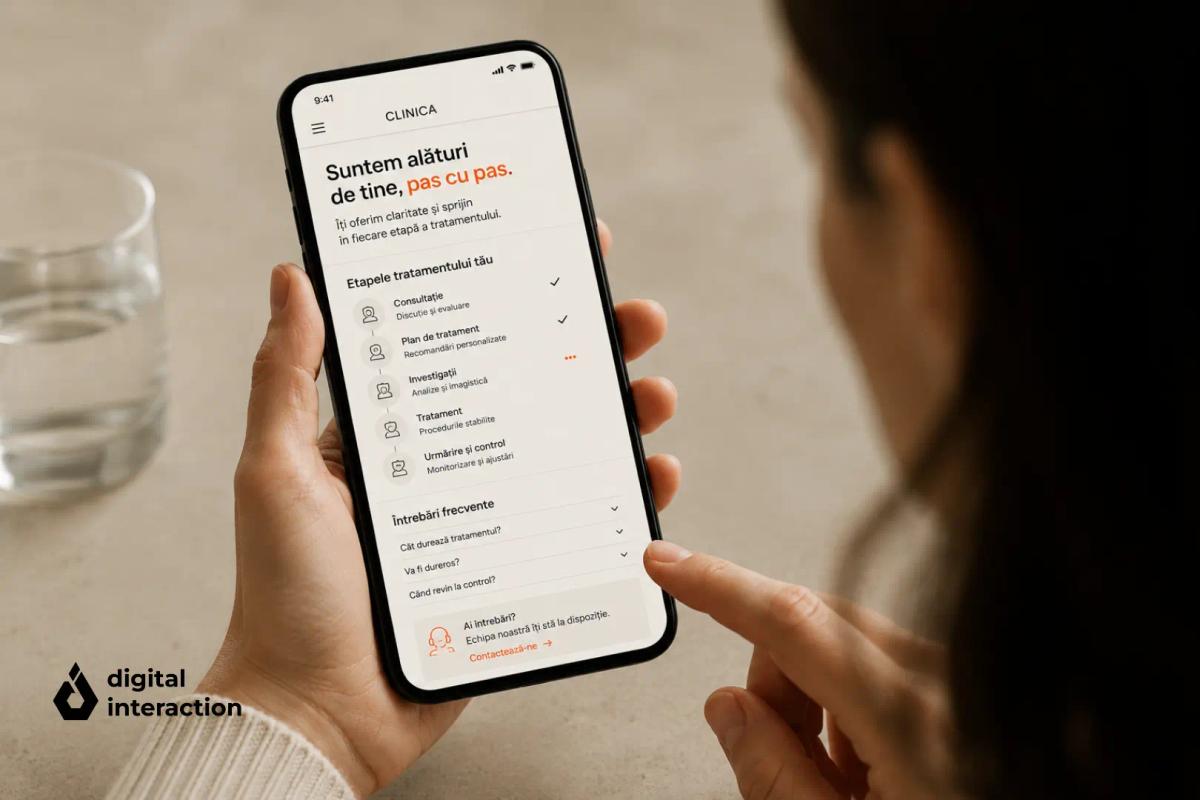

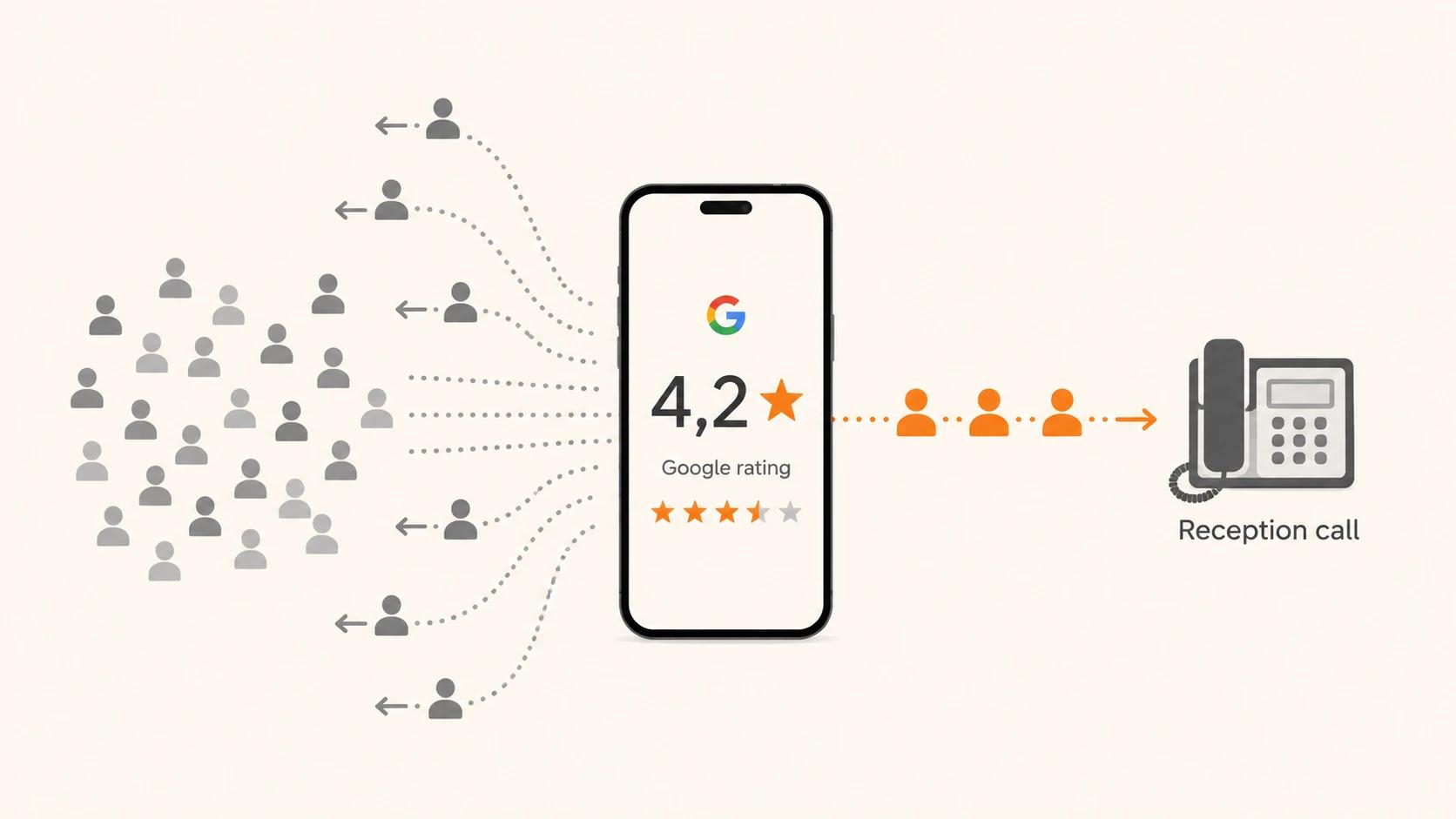
Before a patient ever calls your reception desk, they have already run a triage. Not a medical one, a commercial one.
They opened Google. They saw your clinic's rating. They read three reviews , usually the most recent ones and the worst one. And in under a minute, they decided whether you made the shortlist or not.
You never heard about this patient. They don't appear in any report. They never filled in a form. They disappeared before they existed and this is exactly where most clinics lose, in a place nobody measures.
Want to know how many patients your clinic loses in this triage? In a free 30-minute audit we show you exactly where the path breaks between a Google search and a call to your reception, with numbers, not impressions.
Book your audit →
The data: the rating has dethroned the friend's recommendation
For years, reviews were treated as a nice-to-have, something to check occasionally, between more important things. The numbers say otherwise.
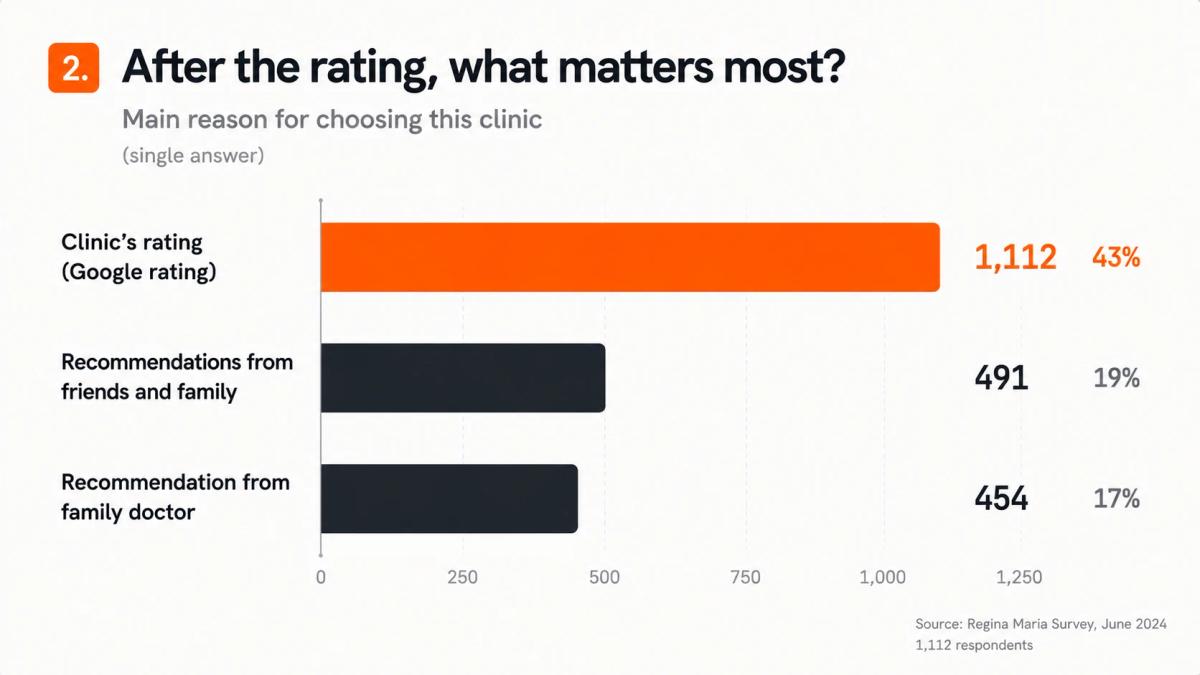
Regina Maria, one of Romania's largest private healthcare networks, asked 2,606 patients how they choose their doctor. The results are worth reading twice:
- 1,112 patients, roughly 43% chose their doctor based on the rating. The publicly displayed score was the number one criterion.
- Recommendations from friends and family? 491 patients. A distant second.
- The family doctor's recommendation: 454 patients. Third.
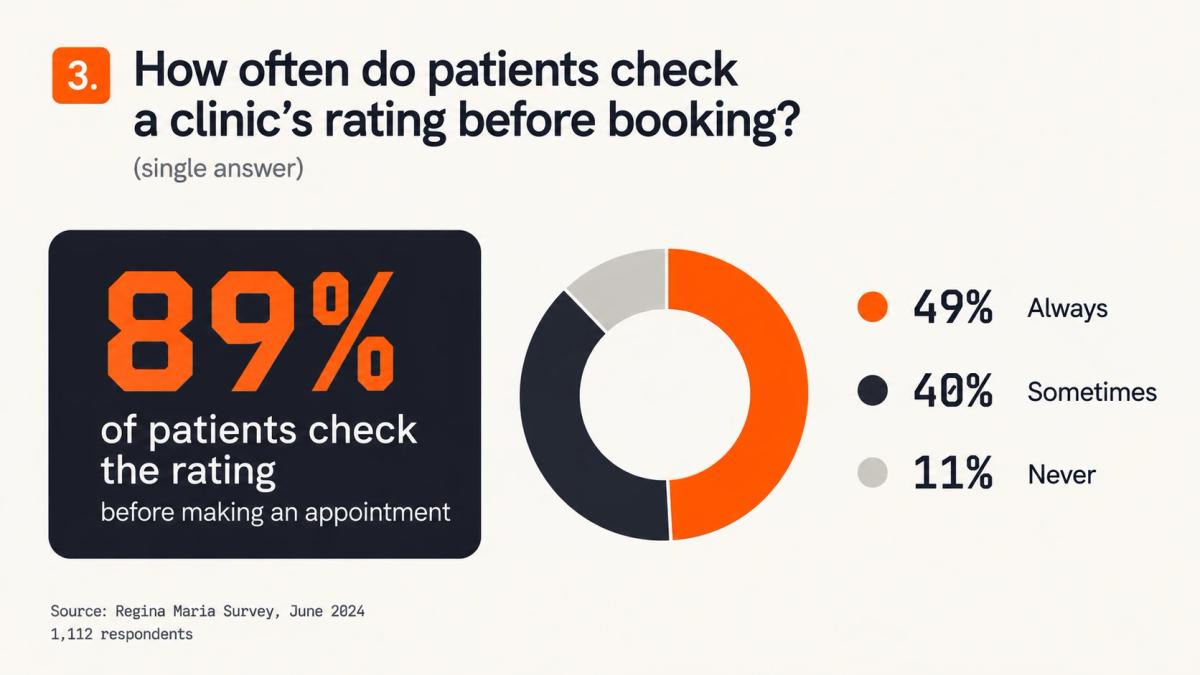
Even more relevant for you: 49% of respondents said they always check the displayed ratings when choosing a doctor. 40% check them sometimes. Only 11% never do.
Read that last figure in reverse: 89% of patients look at the rating at least occasionally. Nine out of ten.
Word of mouth hasn't died. It has moved online, gone public, and now carries a score. The recommendation that used to be shared over coffee now sits permanently next to your clinic's name, visible to every person searching "dentist + your city" at 11 pm.
Why the rating works as a risk filter
Here is the nuance most clinics miss: the patient isn't looking for the best clinic. They are trying to eliminate the risk of choosing a bad one.
A medical decision is nothing like ordering shoes. The stakes are their own body. The fear of choosing wrong outweighs the desire to gain something. So the patient uses the rating exactly the way a doctor uses triage: not to reach a final diagnosis, but to decide quickly who moves forward and who doesn't.
The practical consequence: a weak rating doesn't bring you bad reviews, it brings you silence. The phone rings less often and nobody tells you why. And your ad budget pays more and more for every booking, because you're sending traffic to a profile that rejects people before they ever tap "call".
We have seen this pattern in audit after audit: clinics with well-configured ads and a decent website, but a 4.1 rating and a most recent review eight months old. The budget wasn't the problem. The triage was.
What the patient checks, in the order they check it
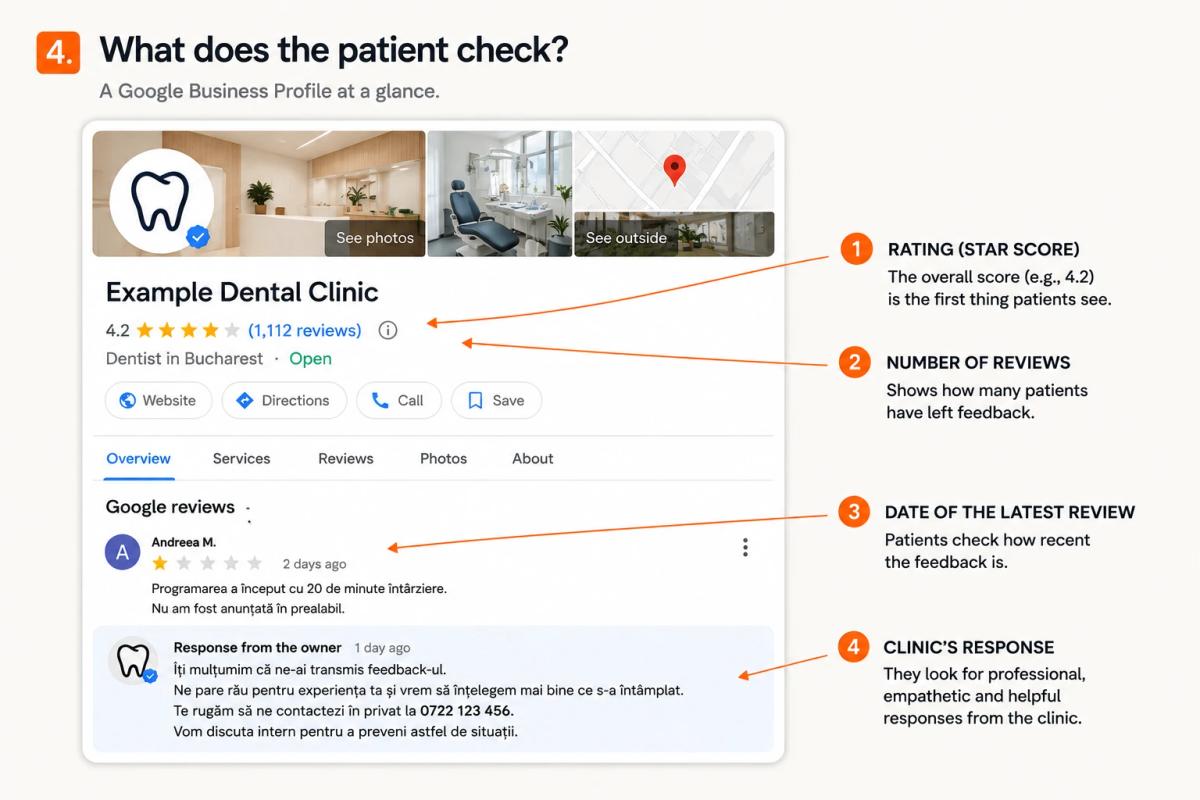
When we audit a clinic's profile, we look at the same four things the patient looks at, without knowing they're doing it:
1. The rating. Below 4.5 on Google, you enter the suspicion zone. Not because 4.3 is objectively bad, but because the competitor two kilometres away has 4.8.
2. The number of reviews. A 5.0 from 12 reviews convinces less than a 4.7 from 400. Volume is the proof that the score wasn't built by relatives and staff.
3. Recency. A most recent review from six months ago raises an uncomfortable question: what happened since? Fresh reviews signal a living clinic.
4. The replies. The patient reads the negative review, then reads what you answered. They don't judge you for the fact that someone complained, they judge you by how you reacted.
Point, example, consequence: if three of these four criteria work against you, your ad campaign is paying to convince people your profile loses for free.
How to build a review system, not a begging campaign
The difference between clinics with 40 reviews and clinics with 400 is not the quality of the medical care. It is the existence of a process. Good reviews don't happen, they get collected.
Step 1. Ask at the right moment, not the convenient one
The moment with the highest response rate is immediately after a visibly positive experience: the end of a treatment, the check-up where everything looks good, the moment the patient thanks you. Not three days later, through a generic email.
A simple script for reception: "We're glad everything went well. If you have a minute, a review helps other patients find us, we'll text you the link right now." Send the direct link to the review form, not to the clinic's page. Every extra click halves the completion rate.
Step 2. Automate the request
Tie the review request to your booking flow: an automated SMS or email, the same day as the visit, with a direct link. A clinic with 300 consultations a month and a response rate of just 5% adds 15 reviews monthly, 180 a year. That separates your profile from the competition more than any campaign.
One thing to be careful about: ask everyone, not only satisfied patients. Selective filtering, review gating, violates Google's policies and, if detected, can cost you the reviews you've accumulated.
Step 3. Reply to everything, especially the negative reviews
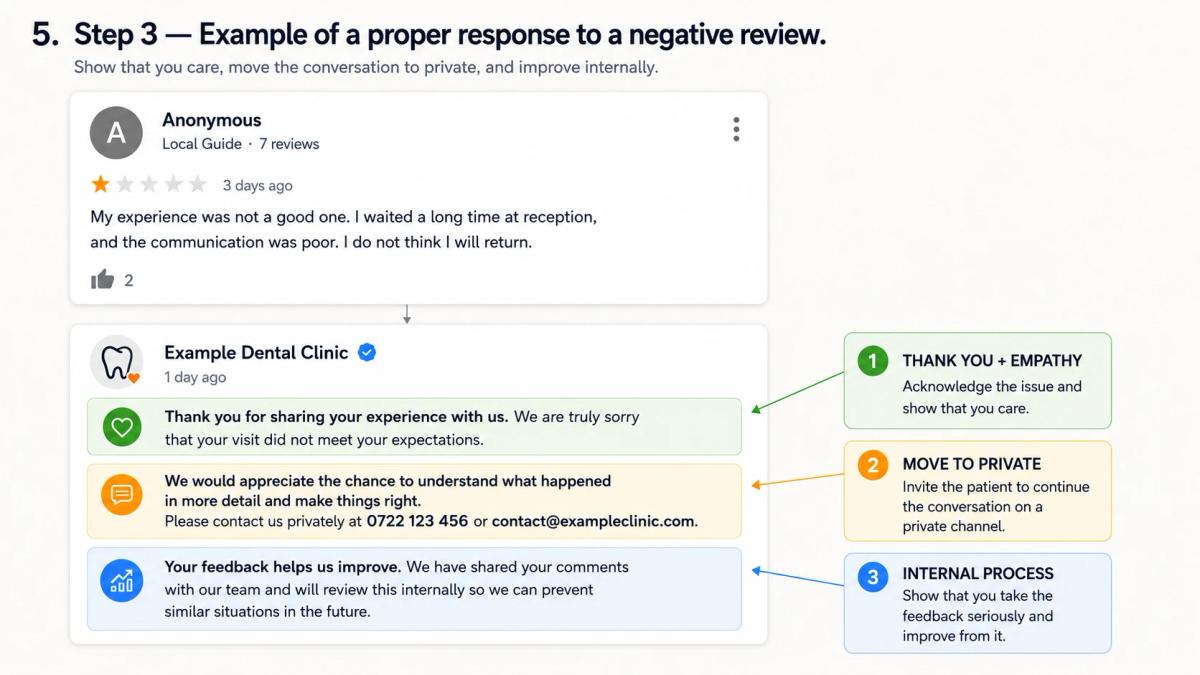
For positive reviews: short, personal, no visible copy-paste.
For negative ones, the formula has three parts: thank them for the signal, move the conversation to a private channel ("please contact us at…"), and show there is an internal process. No defensive excuses, no attacks on the patient.
And one line you never cross: never publicly confirm that the person was your patient, and never share any medical detail in your reply. Confidentiality is not suspended just because the patient spoke first. The correct reply protects both the patient and the clinic.
Step 4. Measure it, like any other channel
Three indicators, tracked monthly: average rating, new reviews per month, and your clinic's reply rate. If they don't sit on a dashboard next to your cost per booking, they don't exist. What isn't measured isn't managed and reviews today are an acquisition channel, not a PR line item.
Reviews are not an isolated channel. They are the trust layer of your entire system
In the Conversion Architecture, our framework for diagnosing and building marketing systems, reviews work in two layers at once.
In Capture, they decide whether the traffic you pay for turns into phone calls. Same ad, same budget, same website, a 4.8 rating versus a 4.2 radically changes how many people end up calling. Reviews are the silent multiplier of every unit of currency you invest in Attraction.
In Retention, the review request is the first step of the post-treatment relationship. A patient who has left a public review has committed to their choice, they return more easily, and they refer more readily.
That is why we never treat reviews as a side project handed to someone "when they have time". They are infrastructure.
What you can do this week
Search for your clinic on Google, the way a patient would. Write down: the rating, the number of reviews, the date of the most recent review, and whether you replied to the last five.
Run the same exercise for your top three local competitors. Now you know what the triage looks like from the patient's side.
If you don't have an automated review-request flow, build one. It is the cheapest marketing project with a direct impact on bookings you can start this month.
The patient runs the triage either way. The only question is whether your profile passes it.
Find out where the triage stops you, before you pay for another month of ads
If the four criteria above raised even one question mark, don't guess. Measure.
In a free 30-minute audit we walk through your clinic's profile exactly the way a patient does: rating, volume, recency, replies and we show you how each one translates into bookings lost or won. No obligation, no sales pitch. You leave with a concrete list of next steps, whether we end up working together or not.