
Medical marketing for clinics: how to build a system that brings patients, not just website visits
Medical marketing is the set of strategies through which a clinic or practice becomes visible, earns patient trust and turns online searches into booked appointments, while staying within the bounds of healthcare law and professional ethics. The difference from ordinary marketing is not subtle: your audience is not buying a product, they are trusting you with their health. And the rules do not let you promise outcomes.
This guide is not a list of "trends". It is how we, at Digital Interaction, actually build patient acquisition systems for the clinics we work with: step by step, in the right order of priorities, and with the mistakes we see most often across the market.
1. Why your clinic does not have a visibility problem, it has a system problem
Most clinics that reach out describe the same situation: "We have a website, we have social media, we even ran some ads. Patients still are not coming from online."
The problem is almost never a lack of activity. It is that the activities are not connected to one another. A good ad sends people to a weak page. A good page has no reviews to back it up. The reviews exist, but nobody answers the phone after 5pm. Every weak link cancels out the investment made in the strong ones.
We call this conversion architecture: the patient does not decide in a single place, they move through a chain of search, comparison, verification, contact and booking. Medical marketing that works does not optimise one channel, it optimises the whole chain. The rest of this guide follows exactly that logic.
2. The patient journey: the five moments where you are chosen or ruled out
Before tactics, it helps to understand what the 2026 patient actually does. The behaviour is remarkably consistent across specialities:
Moment 1, the search. Over half of patients start online with a "service plus city" query ("dental implant Manchester", "dermatologist near me"). If you do not appear here, nothing else matters.
Moment 2, the comparison. The patient opens two to four options in browser tabs. You win or lose in seconds: the clarity of the site, whether prices are shown, the faces of the clinicians.
Moment 3, the verification. Before calling, the patient checks the Google rating and reads recent reviews. Not the overall average, the recent ones. A clinic sitting on 4.9 from 2022 with nothing new loses to one at 4.6 that gets feedback every week.
Moment 4, the contact. Phone, WhatsApp or form. Every hour of delay in responding sharply reduces the chance of a booking; the patient already has two other tabs open.
Moment 5, confirming the decision. After booking, the patient keeps reading. A clear confirmation email, a reminder and information about what comes next reduce no-shows and start the long-term relationship well.
Each chapter below strengthens one or more of these moments. That is the correct order of prioritisation: not "which channel is fashionable", but "where the chain breaks for us".
3. The foundation: the website and the page that turns visits into bookings
No campaign can make up for a website that does not convert. Before you spend a penny on ads or SEO, the site has to pass one simple test: can a patient who has never heard of you understand, within 10 seconds, what you do, where you are and how to book?
The elements that make the difference, in order of impact:
- A dedicated page for each main service. Not a list of 30 services on one page. "Dental implants" gets its own page, with the procedure explained, a price range, the clinician responsible and a booking button. This serves both the patient and your SEO.
- Prices or price ranges shown. Clinics fear this the most, yet it is one of the strongest quality filters there is. A patient who cannot find any price signal leaves for the clinic that gives them one.
- Booking in two steps at most. A visible button on every page, a short form or a direct WhatsApp link. On mobile, the call button should stay fixed on screen.
- Real people. Photos of the team, the clinicians' names, their specialities. A patient does not book with a clinic, they book with a person.
- Speed on mobile. More than 60% of medical traffic comes from a phone. A page that takes over 3 seconds to load loses patients before they get a chance to say anything.
4. Medical SEO: how to reach the patient at the exact moment they search
Medical SEO is the most valuable long-term channel for one simple reason: the patient who finds you organically is already looking for you. You are not interrupting them, you are answering them.
4.1. Start with your Google Business Profile, not the blog
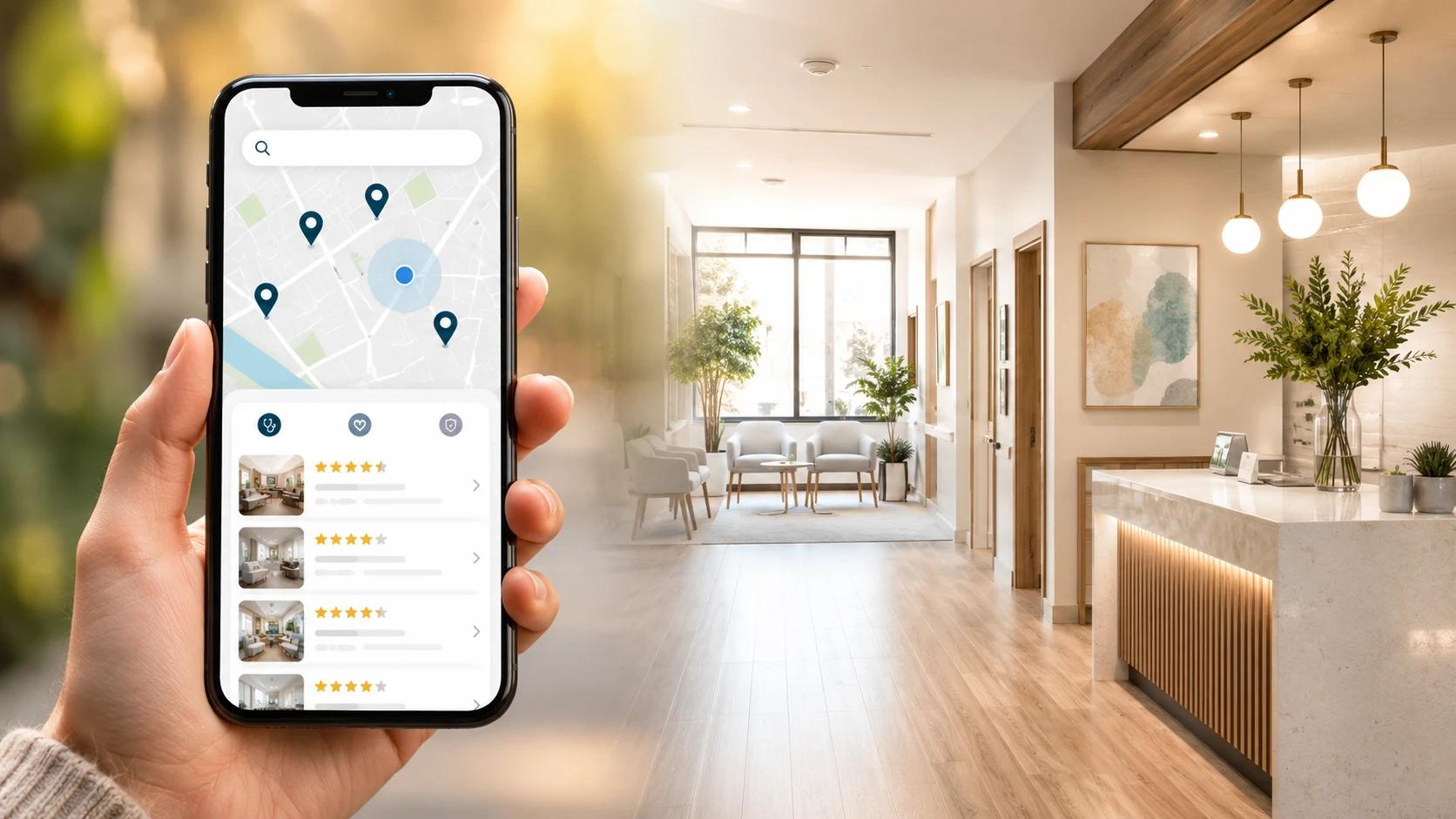
For a clinic, the most important "website" is not the website, it is the Google Business Profile. It appears in the map results (the Local Pack) for almost any local medical search and shows the rating, reviews, opening hours and a call button directly.
The non-negotiable minimum: every field completed, correct categories, real photos (not logos), hours kept current including over holidays, a reply to every review and the occasional post. It is free, and it beats any poorly built paid campaign on impact.
4.2. Keywords: service plus location, not "about us"
Patients search extremely specifically: "pregnancy scan cost", "emergency dentist open now", "recovery after ligament surgery". Each such search needs a page that answers it precisely.
The classic mistake: a blog about topics the clinic finds interesting ("We attended conference X"), rather than what patients search for. Before writing any article, check whether the topic has real search volume.
4.3. Educational content: authority, not volume
Google favours sites that cover a topic in depth. A dental clinic with 15 solid articles about implants, extractions, hygiene and recovery will be treated as an authority on dentistry, and will appear more often than one with 40 scattered posts.
In 2026 a new layer is added: AI Overviews and generative engines. Google, ChatGPT and Perplexity cite sources that answer clearly, with direct definitions, a question-and-answer structure and verifiable data. Vague content written "just to have something" becomes invisible twice over: to patients, and to AI.
5. Google Ads for medical practices: when it pays off and when you burn budget
Google Ads is the channel with the clearest intent: the patient typed exactly what they are looking for. But it is also where clinics waste the most money, for three recurring reasons:
1. The ad points to the homepage. The patient searched "teeth whitening cost" and lands on a general page about the clinic. They do not find the answer, they leave, you pay for the click. Every campaign needs its own landing page, built around the service being promoted.
2. There is no conversion tracking. Without measuring calls and form submissions, the campaign optimises for clicks, which means for cost, not for patients. After a month, "we spent 2,000" tells you nothing if you do not know how many bookings came out of it.
3. Keywords that are too broad. "Dentist" brings in medical students and people looking for jokes. "Dental implant cost [city]" brings in patients. The cost per click is higher, but the cost per patient is lower.
The practical rule: Google Ads is worth switching on after the landing page converts and tracking works, and it shines for high-value services (implantology, orthodontics, surgery, imaging), where a single patient covers the monthly budget.
6. Meta Ads and social media: education, not a billboard
Facebook and Instagram work differently from Google: here the patient is not searching for anything. They are scrolling. That changes what works entirely.
Ads that perform in healthcare on Meta do not sell, they educate or dismantle a fear: "Why dental implants do not hurt in 2026", "3 signs it is time for a skin check", a clinician answering the single most common question from the consultation room in 45 seconds. Elective services (aesthetics, cosmetic dentistry, dermatology) are the natural ground for Meta Ads, because the decision is planned, visual and emotional.
For organic content, the 80/20 rule remains the best compass: 80% education and people (clinicians, atmosphere, tips, behind the scenes), 20% promotional. Clinics that post only prices and offers train their audience to ignore them.
One detail few clinics know: Meta classes health under special ad categories, with restrictions on targeting and wording (you cannot imply you know a person's health status, you cannot use aggressive "before / after" imagery for certain procedures). A campaign written without these rules risks repeated rejections or even a restricted ad account. We cover the full compliance picture in chapter 9.
7. Reviews: the patient's new triage
If we had to pick a single factor that decides the booking, it would be recent reviews. The patient uses them as a risk filter, exactly the way a clinician uses triage. The data is unambiguous: a large share of patients choose a doctor based on their rating, and close to half check the rating every time before a new booking.
What proper review management looks like in practice:
- Systematic collection, not occasional. After each consultation, the patient automatically receives an SMS or email with the direct link to the Google review. "Systematic" is the key word: four or five new reviews a month beat 50 old ones.
- Reply to everything, within 48 hours. A short thank you for the positive ones; calm, empathy and an invitation to talk privately for the negative ones. The reply is not for the reviewer, it is for the next 500 patients who read it.
- No fake reviews. Ever. Beyond the risk of a Google penalty, patients detect them surprisingly well, and a single exposed fake destroys more than ten real ones built.
- Reviews on the site. Embedded on service pages, next to the booking button, exactly at the moment of decision.
8. Email, SMS and WhatsApp: the patients you already have
The cheapest new patient is the returning old one. And yet communicating with your existing patient base is the most neglected channel in medical marketing.
What works, in order of impact:
Recall reminders. "It has been a year since your last hygiene appointment", automated, personalised to the patient's history. It fills the diary at almost zero cost.
Post-consultation follow-up. A thank you, aftercare advice and, two or three days later, the review link. A single message that serves both retention and reputation.
WhatsApp as a booking channel. In practice, WhatsApp has overtaken email as the preferred way patients contact a clinic. A visible button on the site (especially on mobile), quick answers to common questions, plus booking confirmations and reminders; the open rate is far higher than email.
An educational newsletter, not a promotional one. Monthly or every two months, with seasonal tips and genuine clinic news. Segmented at a minimum: parents, new patients, returning patients.
One warning, and a serious one: all of this communication rests on documented GDPR consent. A list "gathered over time" without clear consent is not a marketing asset, it is a legal risk.
9. What you can and cannot say: the rules of medical advertising
This is where medical marketing parts company for good with every other industry, and where the clinics that use generalist agencies or "manage on their own" make the most expensive mistakes. The relevant framework:
- Advertising law prohibits misleading advertising and requires any claim to be provable. "Guaranteed results", "the best implantologist in the country", "miracle treatment": all are penalisable wording, not just poor taste.
- Professional codes of conduct strictly limit how clinicians may promote themselves: information is allowed, patient solicitation and comparative or exaggerated advertising are not. A clinician can face disciplinary action for communication the clinic put out in their name.
- GDPR governs everything to do with patient data, from the email list to the tracking pixels on the site. Health data is a special category, with the highest level of protection.
- Platform policies (Google, Meta) add their own layer: restrictions on medical terms, on "before / after", on targeting by health interests.
The practical rule we apply to every piece of material: educate and inform, do not promise. "Here is how the procedure works and what to expect" is legal, ethical and, not by accident, converts better than any superlative. The 2026 patient does not believe superlatives anyway.
(Localisation note: this chapter is written to fit UK-facing content. If the English version is meant for a Romanian audience, the same points map onto Law 148/2000 on advertising, the Romanian College of Physicians code of conduct and GDPR. Tell me which market and I will name the exact bodies.)
10. Measurement: from "we have traffic" to "we know our cost per new patient"
Without measurement, medical marketing is a collection of opinions. With it, it is a business decision. The difference sits in three levels of maturity:
Level 1, vanity metrics. Visits, likes, impressions. Useful as a signal, useless as a decision. This is where most clinics stop.
Level 2, conversions. Google Analytics 4 set up correctly, with events for calls, forms and WhatsApp clicks, split by channel. Now you know that SEO brought 34 enquiries this month and Ads brought 21.
Level 3, cost per new patient. The link between marketing and the front desk: how many enquiries became bookings, how many bookings became attendances. Only here do you learn that a channel that "looks good" actually brings enquiries that never show up, while another, pricier per click, brings patients who stay for years.
The front desk is, in our experience, the most underrated link: you can double your marketing results without adding a penny to the budget, simply by cutting response time to enquiries and systematically chasing the ones that went unanswered.
11. On your own or with a medical marketing agency?
The honest answer: it depends on your stage, and you can do plenty yourself.
What a clinic can do in-house, starting tomorrow: a complete Google Business Profile, systematic review collection, fast responses to enquiries, real photos on the site, a visible WhatsApp button. These are the foundation and they do not need an agency, they need discipline.
Where a specialist agency earns its fee: long-term SEO strategy, paid campaigns (where a poor setup burns real budget month after month), the legal compliance of your materials and the measurement infrastructure.
If you do come to choose an agency, the criterion that matters more than a shelf of awards is one question: have they worked with clinics? Medical marketing has rules, restrictions and a patient psychology that a generalist agency learns at your expense and on your reputation. Good questions to ask in the first conversation: what legal restrictions apply to promoting my services? how do you measure cost per new patient, not per click? what happens to the accounts and the data if we stop working together?
We, at Digital Interaction, work exclusively with clinics and hospitals, from dentistry and aesthetics to multidisciplinary centres. If you want a second opinion on your current situation, we offer a free clinic audit: 15 minutes in which we tell you plainly where the chain breaks and what to change first. No commitment and no sales pitch.